

Every modern convenience is pitched as liberation. Groceries appear at your door with a thumb strike. Noise-canceling algorithms edit ambient city sounds out of your skull. Climate control guarantees that your skin rarely experiences air more than two degrees away from seventy. Software engineers labor around the clock to eliminate every microsecond of friction between your fleeting desire and its immediate satisfaction.
We call this progress. Often, we even call it wellness.
Yet beneath this cocoon of seamless ease, something fragile is taking root. When life operates with near-zero resistance, the threshold for distress collapses. An unexpected five-minute traffic delay feels intolerable. A lost internet connection induces physical restlessness. An uncomfortably warm room ruins an entire afternoon. We have built an environment that satisfies every whim, and in doing so, we have engineered minds that shatter at the first sign of unpredicted friction.
Ancient philosophy anticipated this exact decay two thousand years before the first smartphone screen illuminated a dark bedroom. The Stoics recognized that unchecked comfort is not peace. It is a slow, quiet trap.
The Architecture of the Wellness Trap
Modern wellness culture frequently confuses anesthesia with strength. It treats discomfort as an error code, an invasive species to be eradicated through optimization, ergonomic cushions, and endless self-care rituals. If you feel uneasy, the prescription is almost always more cushioning, better lighting, or an app designed to soothe your nerves.
There is nothing wrong with comfort in itself. Seneca was a wealthy statesman who possessed estates and influence. He did not advocate for needless misery. But Seneca saw clearly what luxury does to the ruling faculty:
“Set aside a certain number of days, during which you shall be content with the scantiest and cheapest fare, with coarse and rough dress, saying to yourself the while: ‘Is this the condition that I feared?’”
When convenience becomes your baseline, it ceases to be a tool and becomes a prison. You become dependent on external conditions remaining perfectly aligned for your composure to survive. The moment those conditions wobble, your peace evaporates.
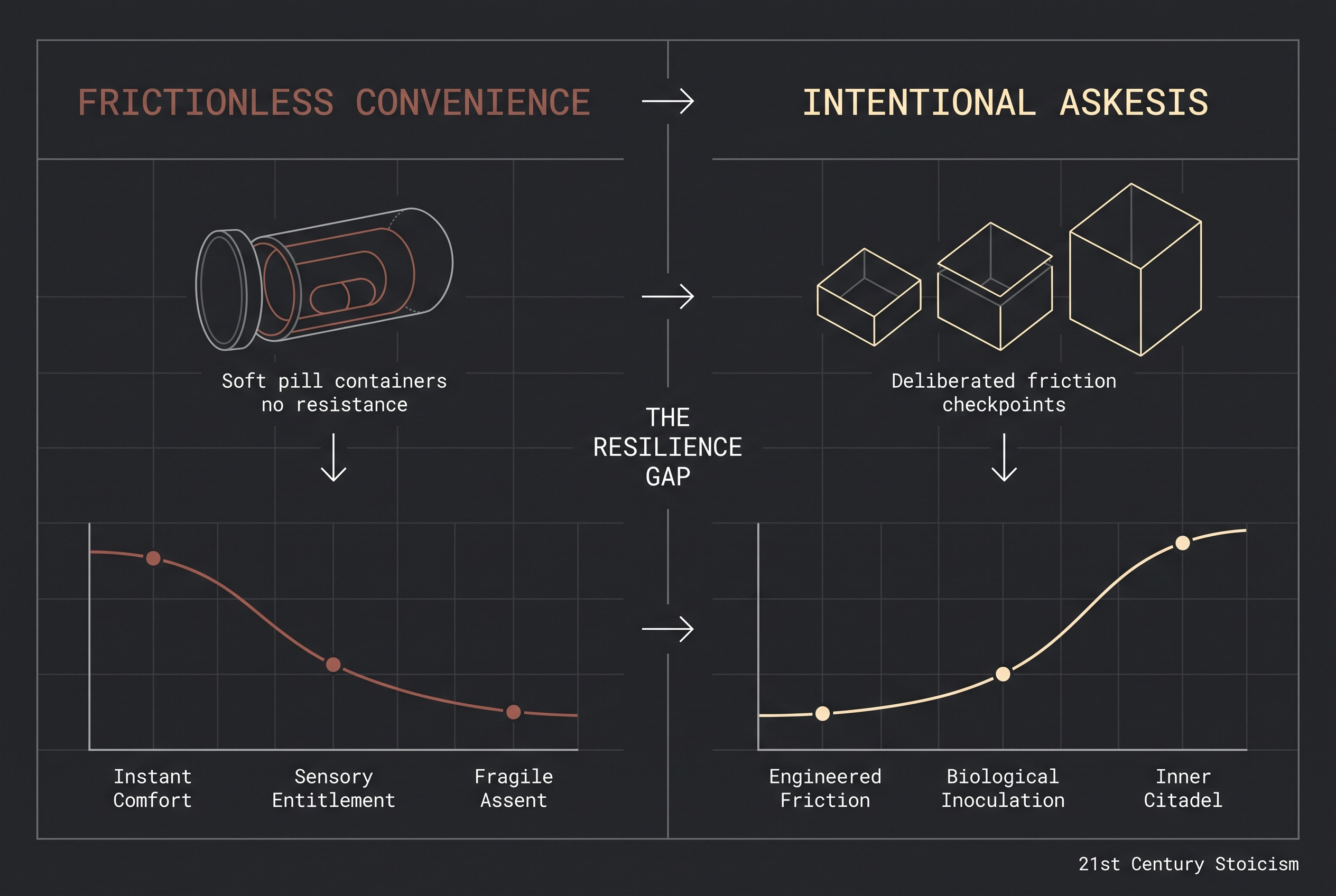
The ancient Stoic counter-strategy was askesis: deliberate, voluntary training. It was not punitive penance. It was preventive inoculation.
Inoculating the Ruling Center
Musonius Rufus, who taught Epictetus, placed physical endurance at the heart of philosophical discipline. He instructed students to accustom their bodies to cold, heat, simple food, and manual exertion. Why? Not because cold water or hard beds possess moral virtue, but because they train the mind to separate a biological sensory impression from a moral catastrophe.
When cold water hits your skin, your nervous system registers an acute shock. If you are unpracticed, your mind immediately adds a layer of emotional panic: This is terrible. I must escape this immediately.
Voluntary discomfort breaks that chain. It opens a deliberate gap between the raw sensory impression and your conscious assent. You feel the cold. You observe the shock. You notice the impulse to flinch. And you remain calm, reminding yourself: This is merely a physical sensation. My capacity for reason is unharmed.
If you can maintain composure while cold and hungry, a delayed flight or a scathing email cannot touch you. You have already faced discomfort on your own terms.
Practical Protocols for Digital Friction
Voluntary discomfort in the twenty-first century does not require sleeping on stone floors or abandoning modern civilization. It requires something far more relevant: injecting deliberate, designed friction into hyper-convenient environments.
Here is how to practice practical askesis inside modern work and life:
The Device-Free Mile
Leave your phone in a drawer and take a forty-five-minute walk. No podcasts, no audiobooks, no emergency line. Notice the phantom vibration in your pocket and the twitch to check notifications when you hit a red light. Sit with the itch. Let it pass.
The Cold Commute
When the weather turns brisk or wet, resist the reflexive urge to turn the thermostat up immediately or pull on heavy layers before walking to your car. Give your body ten minutes to register the elements. Acknowledge the sensation without complaining.
Deliberate Input Fasting
Dedicate the first ninety minutes of your morning to absolute operational silence. No email scans, no social feeds, no news headlines. Do your morning routines and hardest cognitive work in quiet clarity before letting the external world enter your consciousness.
Carrying the Load
Skip the elevator when you have bags to carry. Walk to run a local errand instead of using a vehicle. Treat physical resistance as a gift that keeps your biology from growing brittle.
The Freedom of Lowering the Floor
Most people spend their lives attempting to raise the ceiling of their comfort, believing that once they earn enough, automate enough, and optimize enough, anxiety will finally cease.
The Stoic does the opposite: they deliberately lower the floor.
When you know that you can survive on coarse bread, walk in the rain, sit in silence without stimulation, and handle unexpected delay without losing your temper, fear loses its leverage over your day. You stop being a hostage to favorable weather, responsive servers, and smooth schedules.
Comfort makes a terrible master. Choose your friction before the world chooses it for you.
If you want a concrete system to audit where external comfort has made your daily operations fragile, explore The Dichotomy Filter. It is a simple Notion protocol designed to separate daily disruptions from your sphere of agency.
Stay deliberate,
Torsten