


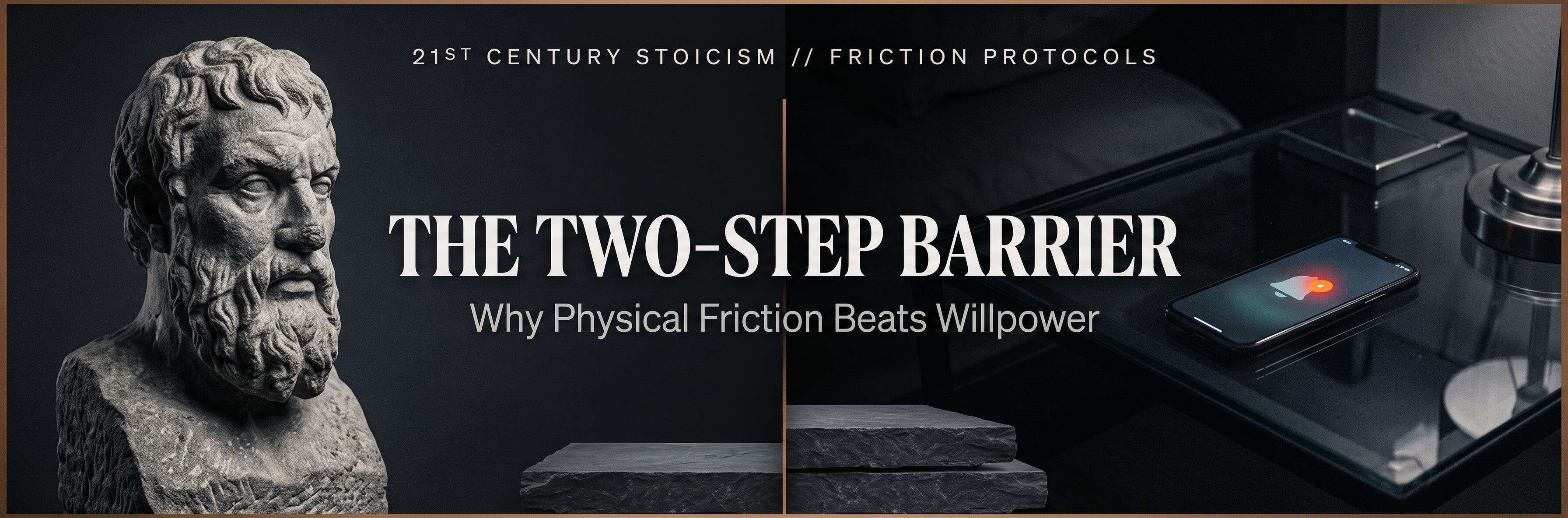
1. The Zero-Friction Trap
Pick up your phone right now and observe what happens.
Biometric sensors read your face or fingerprint in fractions of a second. The lock screen dissolves without a single conscious decision on your part. Before your reflective faculty has evaluated whether picking up the device serves any purpose, your thumb is already cycling through feeds.
Modern consumer hardware is engineered to eliminate physical resistance. Every interface update, every sensor calibration, and every swipe gesture is designed to lower the barrier between an impulse and its execution until that barrier ceases to exist.
When resistance drops to zero, habit takes over. You do not choose to scroll; your nervous system simply follows the path of least mechanical resistance.
2. The Myth of the Willpower Muscle
Self-help culture treats self-control like an internal muscle that you simply need to flex harder. If you lose an hour to mindless browsing at 9:00 PM, the standard diagnosis is moral weakness. You should have had more discipline. You should have meditated more. You should have wanted focus badly enough to resist.
This advice ignores basic human biology. Willpower is an exhaustible resource, not an infinite reservoir.
If you spend eight to ten hours managing inventory, troubleshooting supplier delays, handling difficult customer exchanges, and making hundreds of operational decisions, your cognitive reserves are drained by the time you sit down in the evening. When mental fatigue sets in, the prefrontal cortex cannot run continuous defensive checks against frictionless temptations.
Relying on moral resolve at the end of an exhausting day is an amateur defense mechanism. If an unobstructed phone sits on the nightstand or armrest, scrolling is not a possibility; it is a mathematical certainty.
3. The Classical Precedent: Altering the Environment
Classical Stoicism never treated self-control as an isolated mental contest against immediate temptation. Epictetus was blunt about human vulnerability when exposed directly to triggers. In the Discourses, he noted that if you put an untrained mind in continuous contact with what seduces it, the mind will eventually capitulate.
His directive was not to stand ground and strain against desire; it was to physically withdraw. When an impulse strikes, Epictetus advised creating space: “Do not be hurried away by the impression, but say, ‘Wait for me a little, impression; allow me to see who you are and what you are an impression of.’”
The ancient Stoics altered their physical exposure, their diet, and their living quarters because they understood that reason requires an operational buffer. If you do not give your reflective mind time to inspect an impression, assent is granted automatically. Physical friction is the modern realization of that operational buffer.
4. The Two-Step Barrier Protocol
The Two-Step Barrier is a physical architecture protocol designed to protect your attention when mental energy is at its lowest.
The rule is straightforward: Every device capable of passive consumption must require at least two distinct physical actions to access.
A single barrier is easily bypassed by reflexive muscle memory. Reaching into your pocket or sliding a finger across a glass surface requires no genuine awakening of reason. Two physical barriers break the trance.
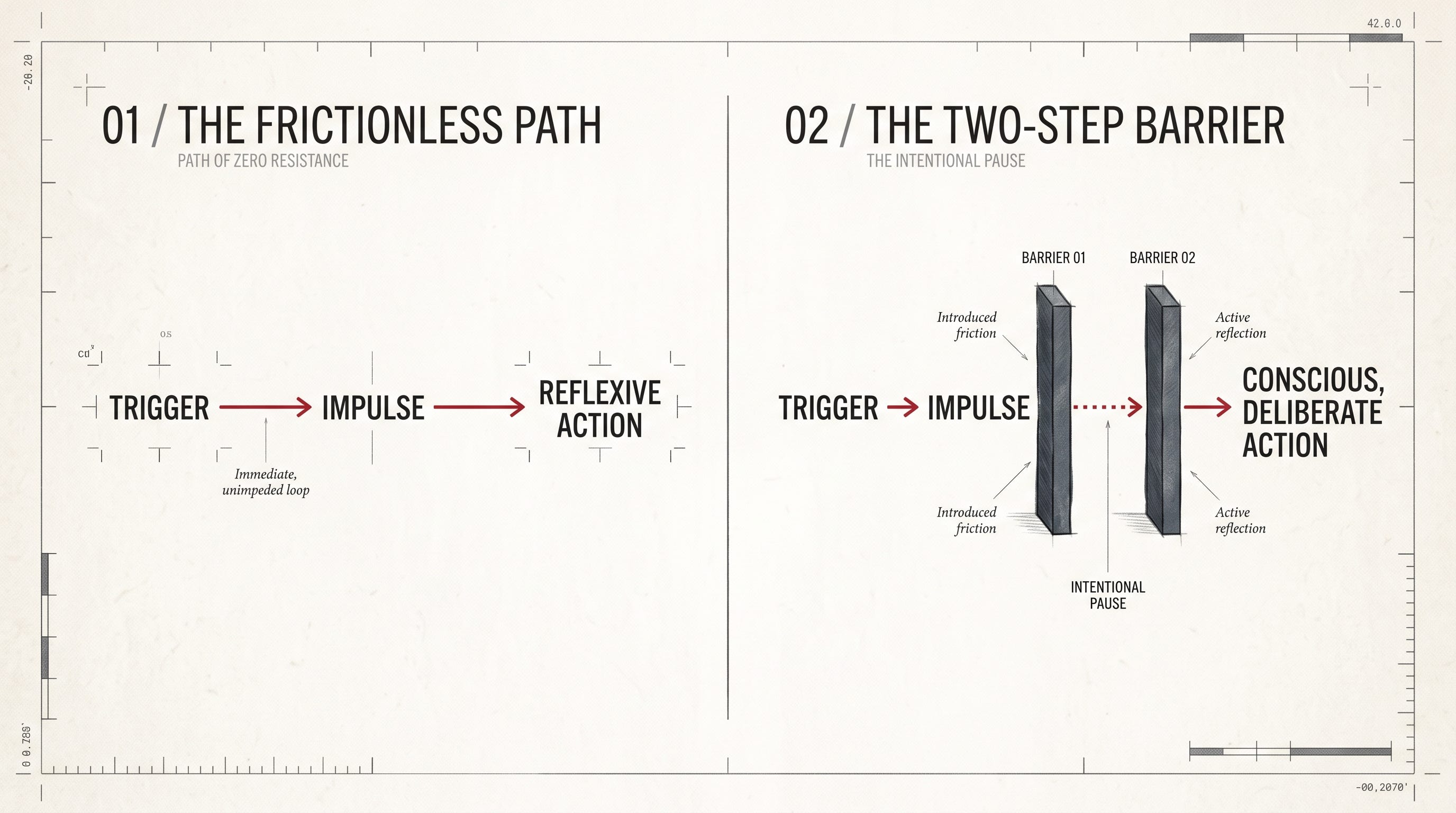
Here is how the protocol operates in daily practice:
Protocol Layer 1: The Out-of-Room Charging Station
The primary device never sleeps in the room where you rest, read, or deliberate.
Step One: You must stand up from your chair or get out of bed.
Step Two: You must walk through a doorway into a hallway or utility area where the charger resides.
By the time you complete step one and step two, the automatic reflex has been interrupted. The half-second trance is broken, giving your critical faculties time to register: Why am I walking across the floor to pick up a piece of glass?
Protocol Layer 2: The Manual Passcode Lockout
If a device must remain in your workspace, eliminate biometric unlock entirely.
Step One: You must physically retrieve the device from a closed drawer or dedicated cabinet.
Step Two: You must manually type a complex, 16-character alphanumeric passphrase.
Typing sixteen deliberate characters requires fine motor control and conscious cognitive engagement. It forces the prefrontal cortex back online before a single application can load.
5. The Evening Threshold
In On Anger, Seneca described his nightly ritual of self-examination: “When the light has been removed and my wife has fallen silent, aware of this habit that is now mine, I examine my entire day and measure my deeds and words.”
Seneca did not conduct this audit to indulge in moral guilt. He ran it like a store manager running an evening inventory count: what went right, where was there slippage, and what structural leak allowed chaos to enter?
If you slipped into digital distraction today, stop blaming your moral character. Inspect your physical safeguards instead:
Did you leave the device on the table within arm’s reach?
Did you leave biometrics enabled?
Did you fail to put a physical boundary between your fatigue and the trigger?
Do not resolve to try harder tomorrow. Redesign the room tonight.
If you want a concrete, pen-and-paper operating system to audit where your attention leaks and enforce daily boundaries, download the FREE 5-Day Printable Stoic Protocol.
Grabbing the Day 1 worksheet (The Morning Armor Audit) puts you on our daily five-part sequence, delivering one single-page protocol to your inbox each morning with zero digital clutter.
Prefer an automated digital workspace over paper? Explore our full library of situational protocols, decision frameworks, and habit systems at The Silent Wisdom.
Stay deliberate,
Torsten