

For most people, the last thing their eyes see before falling asleep is not a loved one, a book, or the quiet dark of their bedroom. It is a four-by-six-inch sheet of glass radiating blue-spectrum light into their retinas.
We crawl into bed exhausted from a day of demands, yet we reach reflexively for the device on the nightstand. We scroll through breaking news, glance at incoming emails, inspect algorithmic feeds of strangers arguing, and tell ourselves we are simply winding down.
In reality, we are doing the exact opposite. We are keeping the central nervous system pinned in an artificial state of hyper-arousal. We invite the entire chaotic world—every crisis, market shift, and digital grievance—into the sanctuary of our bed right as the brain is attempting to consolidate memory and restore physical tissue.
Two thousand years ago, the Roman statesman Seneca practiced a radically different approach to ending the day. He did not retreat into unconsciousness through passive distraction. He treated the evening as an intentional boundary—a ritual clearing of the slate.
If we want clear mornings and resilient minds, we need to reclaim the evening. We need a Stoic Digital Sunset.
Seneca and the Art of Nightly Self-Examination
In his treatise On Anger, Seneca recounts the habit of his mentor, Sextius. When the day was done and he had retired to his bedchamber, Sextius would question his soul:
“What bad habit have you cured today? What fault have you resisted? In what respect are you better?”
Seneca adopted this practice as a sacred daily curfew. When the lamp was removed and his house grew silent, he conducted a thorough audit of his waking hours:
“I examine my entire day and go back over what I’ve done and said, hiding nothing from myself, passing nothing by. For why should I fear any of my errors, when I can say: ‘See that you do it no more, and for now I forgive you.’”
Notice the spirit of Seneca’s audit. It was not neurotically self-flagellating. It was objective, calm, and forgiving. By reviewing his actions with dispassionate honesty, he closed every psychological loop before his head touched the pillow. He fell asleep not in a fog of unresolved anxiety, but with the quiet clarity of a man who knows where he stands.
Compare that to the modern bedtime routine. Rather than examining ourselves, we examine everyone else. We trade self-reflection for an infinite feed of external noise.
Why Blue Light Is Only Half the Problem
Modern health advice around sleep focuses heavily on the physics of light. We are told to buy blue-blocking glasses, install orange screen tinting, or dim the bedroom lamps.
These physical interventions are useful, but they miss the core issue. The primary danger of the late-night phone is not chromatic; it is cognitive.
A smartphone is an open conduit to external chaos. Every tap carries the risk of what Stoics called tarachē—mental disturbance. An email from your manager about tomorrow’s quarterly review. A provocative social post designed by an algorithm to provoke outrage. A text message demanding immediate emotional labor.
When you allow external inputs into your mind in the final hour before sleep, you surrender the ruling center of your mind (hēgemonikon). You let algorithms and strangers dictate your subconscious processing for the next eight hours.
The ancient Stoics built their philosophy around the Dichotomy of Control. When the sun sets, the day’s actions belong entirely to the past—which means they are no longer within your control. Re-agitating your mind over them at midnight accomplishes nothing except exhausting your agency for tomorrow.
The 3-Stage Digital Sunset Protocol
A digital sunset is not an act of technological puritanism. It is a systematic, engineered boundary designed to transition your nervous system from active engagement to quiet restoration.
Here is a practical, three-stage framework to execute every evening:
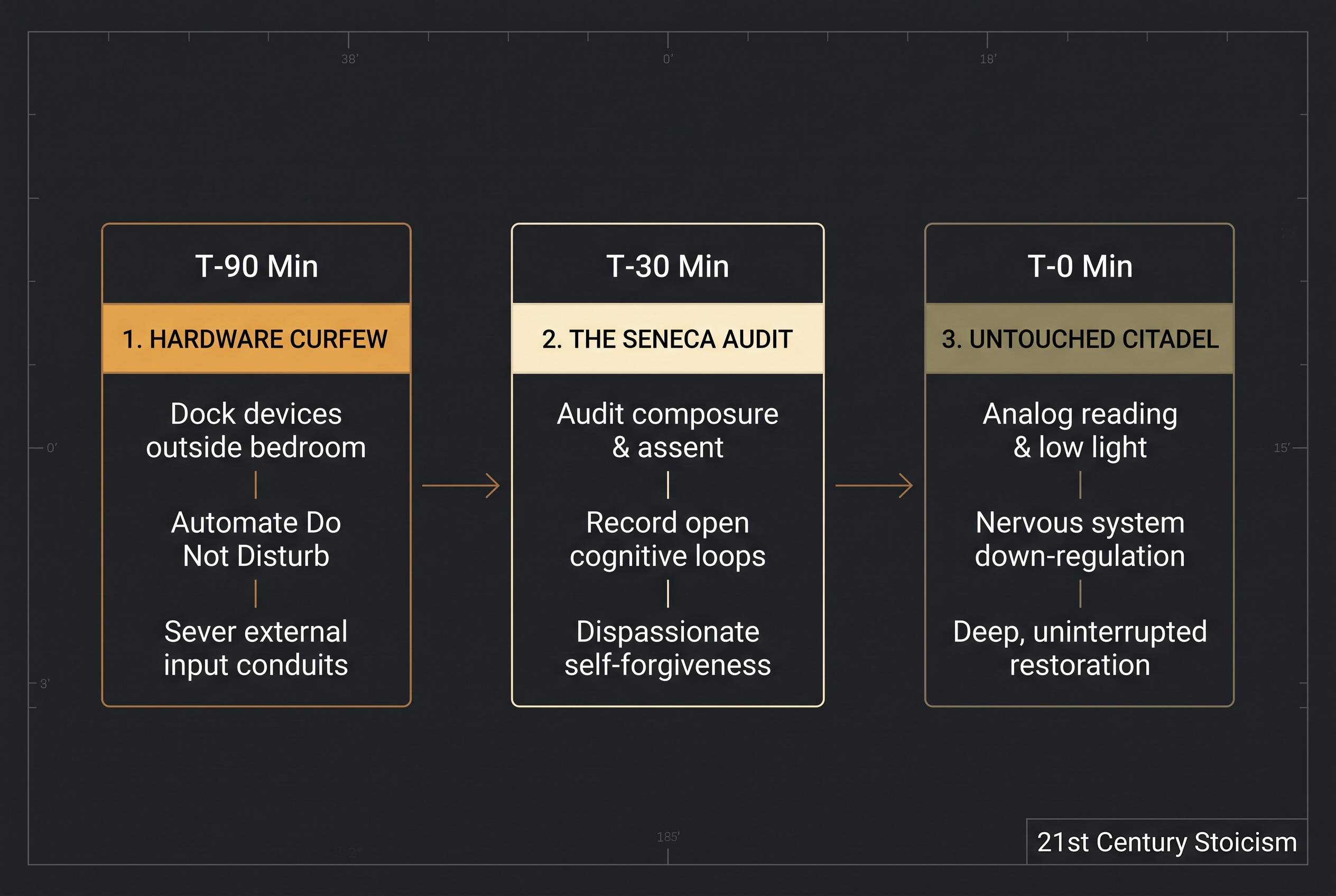
1. The Hardware Curfew (T - 90 Minutes)
At ninety minutes before your target sleep time, transition devices from active tools to dormant appliances.
Place phones, tablets, and laptops on a dedicated charging station outside the sleeping area (a desk, hallway, or kitchen counter).
If you rely on your phone as an alarm clock, purchase a standalone analog or basic digital alarm. The presence of a phone on the nightstand creates subconscious vigilance that degrades deep rest.
Set automated “Do Not Disturb” schedules that silence all notifications except verified emergency contacts.
2. The Seneca Audit (T - 30 Minutes)
Once the digital world is locked outside, sit down with a notebook and spend five dispassionate minutes auditing your day through three simple inquiries:
Where did I lose composure? Did I react with frustration to traffic, an email, or an interrupted plan?
What did I navigate with virtue? Where did I pause between an impression and my assent? Where did I choose patience over reactivity?
What open loop needs closure? Write down the one or two critical tasks for tomorrow so your working memory does not chew on them through the night.
Close the notebook. Forgive yourself for where you slipped. Acknowledge what went well. The day is complete.
3. The Sensory Taper (T - 15 Minutes)
Fill the final minutes before sleep with low-stimulation, offline activities:
Read physical books (fiction, history, or philosophy).
Stretch or complete gentle mobility work.
Dim overhead bulbs in favor of low-level, warm lamps.
Sleeping with a Clear Conscience
Marcus Aurelius frequently reminded himself that each day is a miniature lifetime. When morning comes, we step onto the field to perform our duties. When evening arrives, the contest is over.
There is profound freedom in recognizing that at the end of the day, you have done what you could. Tomorrow will bring its own obligations and challenges, but tonight belongs to peace.
Dock your phone. Silence the noise. Audit your day with honesty and kindness, and let the sun set on your digital world.
If you want a structured format for your evening self-examination, grab our free Stoic Journaling Prompts. It is a printable and digital template featuring Seneca’s nightly questions and morning preparation frames.
Stay deliberate,
Torsten