

Imagine Marcus Aurelius, the philosopher-king of the Roman Empire, sitting in his imperial tent in Carnuntum. Instead of a parchment scroll and a quill, he holds a smartphone. It lights up. A red badge appears. A Slack message from the Senate demands immediate attention. A breaking news alert from the Parthian border slides across the glass. An algorithmically optimized notification reminds him that his latest decree has just been “liked” by a thousand citizens. How would the author of Meditations respond to this relentless assault on his attention?
We live in an era where our most valuable resource—our attention—is continuously harvested by supercomputers. The push notification is not merely a tool of convenience; it is a meticulously engineered behavioral hook designed to exploit our primal dopamine circuitry. For the modern practitioner of philosophy, this presents a unique and unprecedented battlefield. The enemy is no longer a barbarian at the gates, but an algorithm residing securely in our pockets.
The Attention Economy as a Dispreferred Indifferent
In Stoic philosophy, we categorize the world into things we control and things we do not. Between these lie “indifferents”—things that are neither inherently virtuous nor inherently evil. A smartphone, in its purest form, is a preferred indifferent. It connects us, educates us, facilitates our work, and allows us to publish and share ideas.
However, the modern attention metrics, the infinite scrolls, and the dopamine loops? These are textbook “dispreferred indifferents.” They possess no moral weight of their own, but they actively threaten our tranquility if we grant them dominion over our minds. An algorithm’s singular goal is engagement. It does not care about your focus, your peace of mind, or your profound, quiet moments of reflection. It only cares about the duration of your gaze. When we allow our days to be structured by the unpredictable rhythm of pings and buzzes, we are handing over the reins of our guiding reason—our hegemonikon—to a machine learning model designed to keep us perpetually distracted.
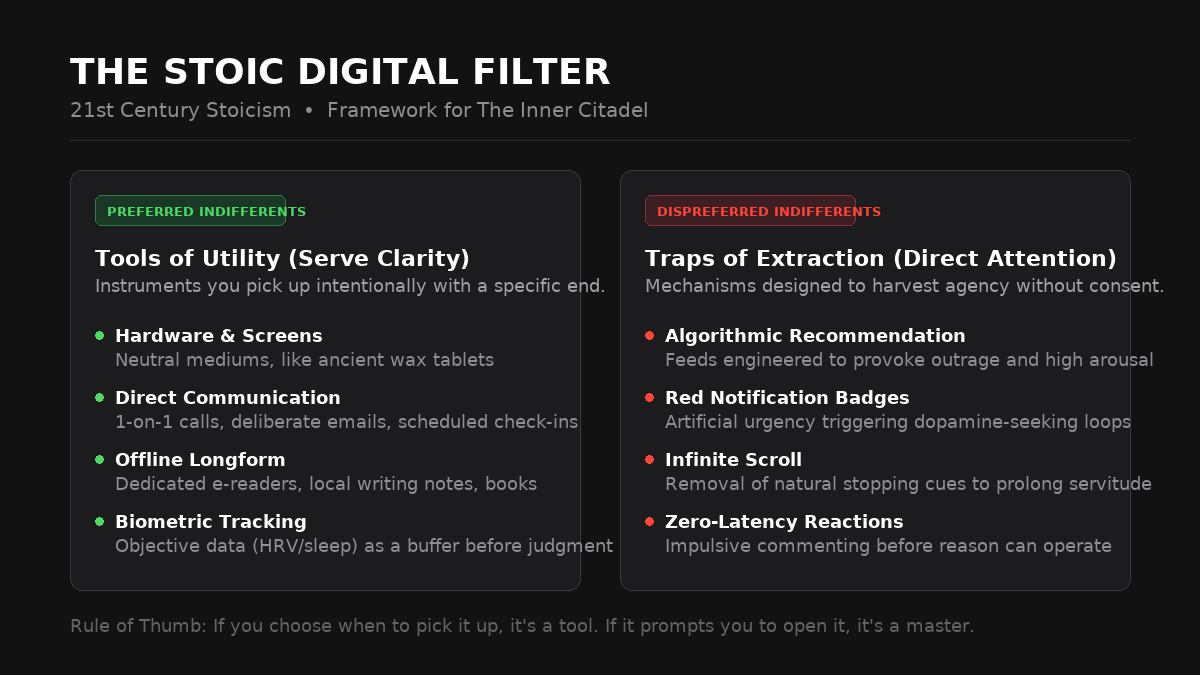
Marcus Aurelius reminded himself, “You have power over your mind, not outside events. Realize this, and you will find strength.” To the Roman Emperor, a push notification would simply be another “outside event”—a tap on the shoulder by an inconsequential courtier. But because these taps now happen hundreds of times a day, they require a modernized, robust defense strategy.
Retreating to the Inner Citadel
Marcus wrote, “The mind freed from passions is an impenetrable fortress—a person has no more secure place of refuge for all time.” He called this the Inner Citadel. Today, that fortress is under constant digital siege. Every ping is a battering ram. Every buzz is a sapper digging at the walls of our focus.
When we react reflexively to every alert, we surrender the keys to the citadel. We allow the present moment—the only thing we truly possess—to be dictated by external code. True digital detachment does not mean abandoning technology and retreating to the woods. It means engaging with the digital world on our own terms, consciously and deliberately, rather than reactively. We must build a moat around our mental real estate.
The Digital Detachment Playbook
To reclaim our sovereignty, we must apply ancient discipline to our modern habits. We must transform digital detachment from a temporary weekend detox into a daily, enduring practice. Here is a practical guide to fortifying your Inner Citadel against the relentless push notification.
Conduct a Control Audit: The foundation of Stoic practice is the dichotomy of control. Apply this to your device. Open your settings and ruthlessly audit your notifications. You cannot control whether developers build addictive apps, but you absolutely control whether those apps have permission to interrupt you. Turn off all non-essential badges, banners, and sounds. If a notification does not require immediate, life-altering action, it should not have the power to break your concentration.
Practice Voluntary Discomfort: Seneca advised setting aside time to practice poverty so that the fear of it loses its grip. We can adapt this into a practice of digital voluntary discomfort. Leave your phone in another room for an hour. Go for a walk without a podcast playing. Sit in a waiting room without instinctively reaching for your screen. The mild anxiety you feel in those initial moments is the withdrawal of a habituated mind. Sitting with that discomfort builds the very discipline necessary to protect your attention.
Implement the Digital Sunrise and Sunset: How we begin and end our days dictates the rhythm of our lives. Establish a “Digital Sunrise”—a strict rule that you will not look at a screen for the first hour of your day. Use this time for reading, journaling, and preparing the mind for the tasks ahead. Similarly, enforce a “Digital Sunset”—powering down devices an hour before sleep. This prevents the blue light and the late-night doomscrolling from disturbing your evening self-examination and rest. Protect the bookends of your day, and the middle will largely take care of itself.
The Silent Victory
In the end, managing our technology is not really about the technology at all; it is about self-mastery. Every time you choose to leave a notification unread, every time you choose a moment of silence over a moment of scrolling, you are exercising your agency. You are proving to yourself that the algorithm is a tool in your hand, not a master of your mind.
Marcus Aurelius ruled an empire amidst war, plague, and political betrayal, yet he found the quiet strength to write, “Nowhere can man find a quieter or more untroubled retreat than in his own soul.” In the age of algorithms, that retreat is more vital than ever. Silence the noise, guard the gates of your attention, and rebuild the walls of your Inner Citadel. The digital world can wait.