



On a humid Tuesday afternoon in downtown St. Augustine, the front door of the shop flies open and a customer walks in already furious.
You can hear it in the chime above the door. You can see it in their posture before they even reach the counter. Their shoulders are up by their ears, their jaw is clenched, and they are scanning the room looking for someone to blame.
Your gut reaction is immediate. Your heart rate ticks up. Your chest tightens. Your brain tells you that an attack is underway and you need to get defensive right now.
Early on in retail, that reaction owned me. I would match their tone, argue policy, or spend the next two hours stewing about how rude strangers can be.
It took me months behind the register to realize what was actually happening. Ninety percent of the anger standing in front of me was manufactured somewhere else. That customer spent forty minutes circling crowded historic streets trying to find parking. Their kids were melting down in the ninety-degree heat. Their flight got delayed the day before, or they had an argument over lunch.
They walked across my threshold carrying an open flame. I was just the first stationary human they ran into.
The Myth of the Armchair Stoic
It is remarkably easy to feel wise when you are sitting in a quiet room reading Seneca with a cup of coffee. You underline a passage about keeping your temper, close the book, and feel like you have things figured out.
Then you step onto a retail sales floor.
Within an hour, someone is leaning over your counter demanding an exchange on an item they bought six months ago with no receipt, raising their voice in front of other shoppers. In that moment, underlined quotes vanish. An abstract slogan does nothing to stop adrenaline from dumping into your bloodstream.
Modern culture treats Stoicism like wall decor. It tells you to be a calm statue, impervious to stress. But Marcus Aurelius was not composing serene affirmations for an aesthetic feed. He was running an empire in the middle of a brutal plague and constant betrayal, trying to keep his composure while people lied to him every morning.
The point of 21st Century Stoicism is not pretending you have no pulse. It is building an operational boundary so you stop volunteering your nervous system as kindling for someone else’s bonfire.
The Two Columns on the Counter
When someone blows up at the register, I do not try to calm them down or debate who is right. I run retail triage.
In emergency medicine, doctors do not take a patient’s high blood pressure personally. When someone comes in bleeding and shouting, the physician does not start shouting back about respect. They treat the injury, ignore the drama, and work the problem.
Behind the counter, that means mentally splitting the interaction into two piles.
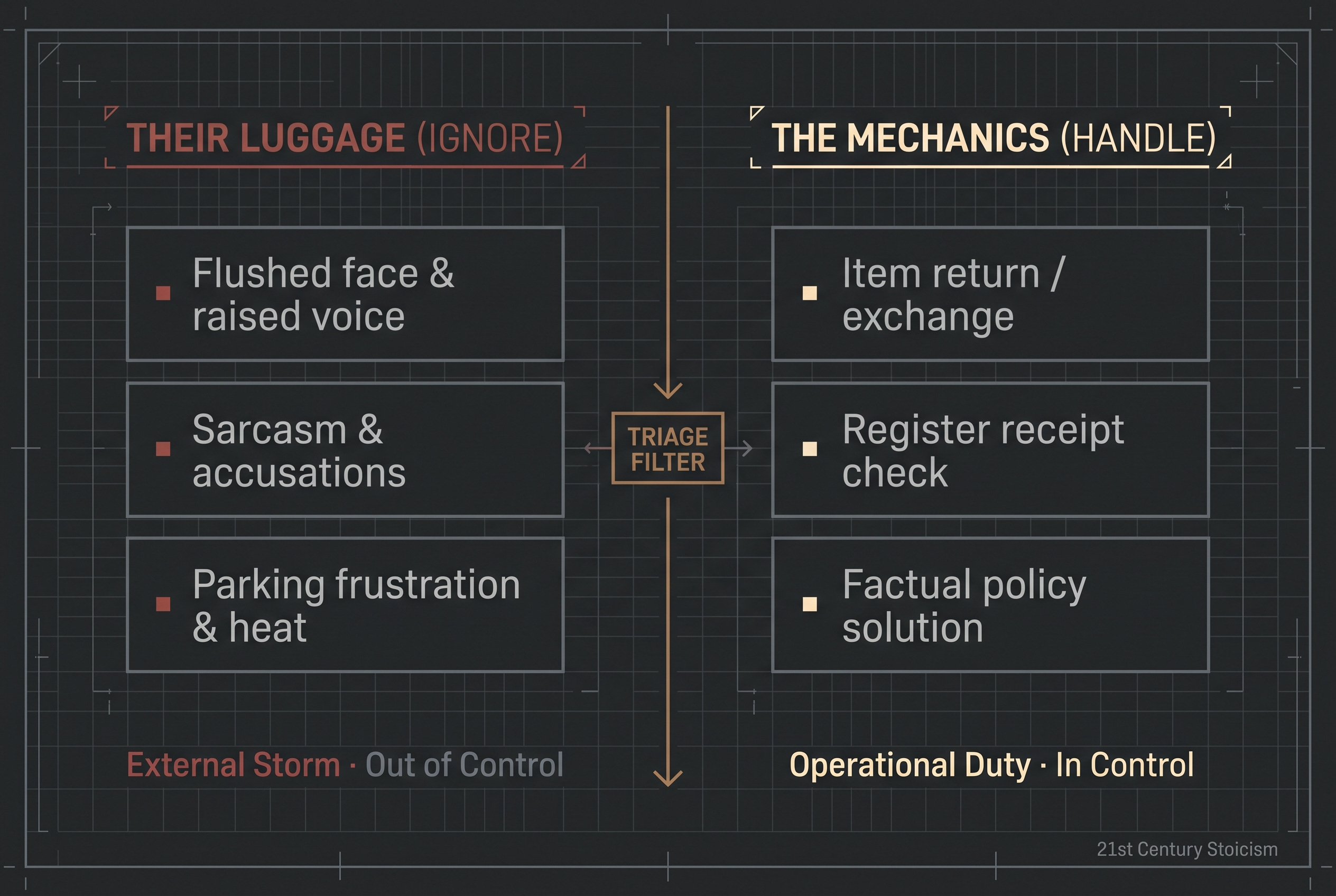
On the left side is their volume, their sarcasm, their bad attitude, and their flushed face. That entire pile belongs to them. It is their luggage, not mine. I have zero control over how they choose to behave, and absorbing it will not fix their problem.
On the right side is the mechanical fact. A broken zipper. A missing bag. A receipt question. A return request. That pile belongs to the store.
My entire job is to handle the right side with crisp, quiet professionalism while completely ignoring the left side.
I take one slow breath before answering, drop my voice half an octave, and speak slightly slower than they do. When they throw an emotional punch, they expect resistance. When they hit dead air and a quiet, reasonable response instead, the fire runs out of oxygen. You solve the issue they actually have, hand them their bag, and let them go.
Guarding the Fortress
Marcus Aurelius talked about the inner citadel, the part of your mind that external chaos cannot touch unless you open the gates and let it in.
The moment you let an angry stranger ruin your afternoon, you handed them the keys.
You spend the rest of your shift short-tempered with your staff. You replay the argument while unpacking inventory in the back room. You get home exhausted, snap at your family, and bring a stranger’s bad day to your dinner table. That customer left your store four hours ago, but you are still letting them dictate how you live your evening.
That is the real cost of failing to triage.
Looking at people through this lens actually breeds patience instead of resentment. When someone loses their mind over a twenty-dollar souvenir, they are not powerful. They are miserable. Someone with that little control over their emotions is living in a personal prison every single day. Their hostility reveals their weakness, not your failure.
You can protect your boundaries and run your business cleanly without letting their storm breach your walls.
Taking the Counter Home
You do not need to run shops in St. Augustine to use this.
The sales floor is just modern life without a screen to hide behind. That agitated customer is no different than the client firing off an accusatory email at 6:30 AM, the coworker leaving passive-aggressive remarks in a team chat, or the relative bringing old grudges to Thanksgiving dinner.
The natural instinct is always to jump in the mud and wrestle.
The next time someone dumps a pile of emotional chaos directly in front of you, stop for three seconds before you react. Separate the real problem from their personal storm. Remind yourself:
I did not light this fire, and I am not required to burn in it.
If you want a concrete system to map out what sits in your control and what belongs outside your gates, check out The Dichotomy Filter. It is a simple protocol designed to keep daily friction from hijacking your headspace.
Stay deliberate,
Torsten