

It happens to the best of us. You sit down on the couch after a grueling Tuesday, pull your phone from your pocket just to check a quick message, and suddenly, the room has gone dark. An hour—maybe two—has vanished. Evaporated into the ether of the infinite scroll.
Two thousand years ago, the Roman statesman and philosopher Seneca penned a blistering essay called On the Shortness of Life. If he were alive today, sitting next to you on that couch, he wouldn’t be lecturing you about the brevity of your existence. He’d be staring at your smartphone, shaking his head at the most efficient time-stealing apparatus ever invented.
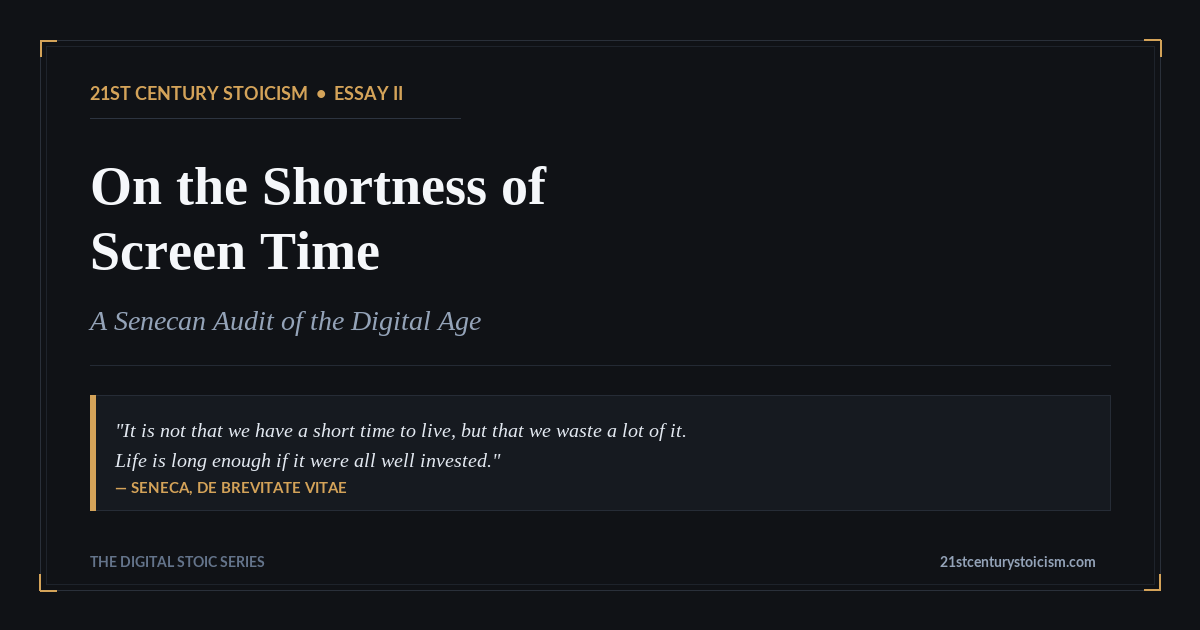
“It is not that we have a short time to live, but that we waste a lot of it,” Seneca wrote. “Life is long enough, and a sufficiently generous amount has been given to us for the highest achievements if it were all well invested.”
When Seneca was complaining about his contemporaries squandering their hours, they were losing time to idle gossip, climbing the political ladder, and tending to vast estates. Today, we forfeit our lives in increments of fifteen-second videos and endless, algorithmic feeds. The medium has changed, but the fundamental tragedy remains identically human. We guard our bank accounts with passwords, PINs, and biometric locks, yet we allow our most non-renewable resource—our time—to be pickpocketed by strangers in Silicon Valley.
The Modern Time-Thieves
We need to get radically honest about what is actually happening when we get sucked into a doom-scroll. We often frame it as “unwinding” or “relaxing.” But look closely at your mental state after forty-five minutes of swiping. Are you rejuvenated? Usually, you feel a low-grade exhaustion, a buzzing numbness that leaves you emptier than when you started.
To translate Seneca into our modern predicament: the algorithm is the ultimate indifferent. In Stoicism, an “indifferent” is something outside your direct control. You cannot control the thousands of engineers whose sole professional mandate is to hijack your dopamine circuitry. You cannot control the machine learning models designed to serve up the exact piece of outrage, humor, or aesthetic perfection required to keep your thumb moving.
What you can control is your assent. The Stoic concept of sugkatathesis—assent—is the moment of space between a stimulus and your reaction to it. The phone buzzes. The screen lights up. The habit loop whispers, “Just one quick look.” In that microscopic window of time, you have the power to either grant your assent to the impulse or withhold it. The problem is that the digital age has practically erased that window. We reach for the phone before the conscious brain even registers the movement.
A Stoic Approach to Limiting the Infinite Scroll
How do we fight back? We don’t do it with vague promises to “be better.” We do it through practical, environmental design and rigorous self-examination.
First, stop blaming yourself for lacking willpower. Willpower is a finite resource, and matching your raw willpower against a supercomputer is a losing game. The Stoic approach isn’t about white-knuckling your way through temptation; it’s about structuring your life so that you are forced to make deliberate choices rather than reactive ones. It is about inserting friction back into a frictionless world.
Seneca was a wealthy man. He didn’t lock himself in a cave to avoid temptation; he learned to live amid wealth without letting it own him. Similarly, we cannot entirely abandon our digital lives. We need email for work, group chats for family, and maps to find our way. The goal isn’t to become a digital hermit, but to become a digital master. You own the device; the device must not own you.
Conducting a Personal Control Audit
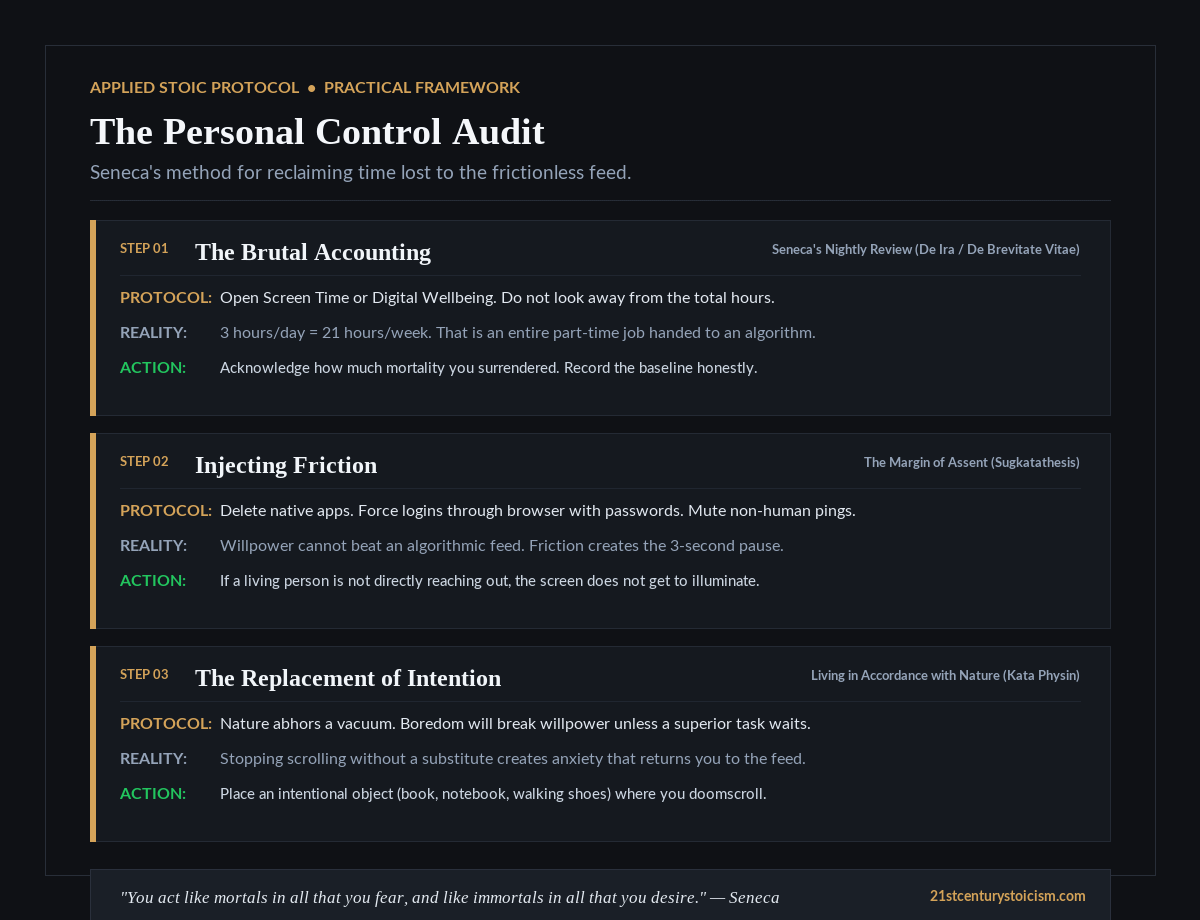
If you want to reclaim the hours bleeding out of your week, it’s time to perform what we might call a Personal Control Audit. This is an exercise in applied Stoic mindfulness.
The Brutal Accounting: Seneca advocated for a nightly review of one’s actions. “When the light has been removed and my wife has fallen silent... I examine my entire day and go back over what I’ve done and said, hiding nothing from myself, passing nothing by.” Open the Screen Time or Digital Wellbeing app on your phone. Do not look away from the number. Let it sting. If you spend three hours a day on social media, that’s twenty-one hours a week. That is a part-time job. That is a novel written, a language learned, a profound relationship deepened. Stare at the accounting. Acknowledge exactly how much of your mortality you are handing over to an app.
Injecting Friction: Now, we restructure the environment. Move the most addictive apps off your home screen. Better yet, delete them from your phone and force yourself to log in through a mobile browser every time. If you want to check Twitter or Instagram, make it an active choice that requires you to type in a password. This introduces a three-second delay. That delay is where your Stoic power of assent lives. In those three seconds, you can catch yourself and ask: “Is this actually how I want to spend my life right now?” Go further. Turn off every single non-human notification. If a real human being is not directly trying to contact you, your phone should not make a sound or light up. The machine does not get to summon you.
The Replacement of Intention: Nature abhors a vacuum. If you simply try to stop scrolling, the sheer weight of boredom will eventually crush your resolve. You must have something infinitely more valuable waiting to absorb that reclaimed time. This requires defining what actually matters to you—what the Stoics called living in accordance with Nature. Keep a physical book on the table where you normally doom-scroll. Place a sketchbook next to the couch. When the phantom urge to reach into your pocket hits—and it will hit hard—redirect that kinetic energy toward the intentional object. You aren’t just running away from the void of the feed; you are running toward something real.
Taking Back the Present
“You act like mortals in all that you fear, and like immortals in all that you desire,” Seneca warned. We swipe through feeds as if we have an eternity of Tuesdays waiting for us. We don’t. The clock is ticking relentlessly, and death is not some distant event waiting at the end of the road; it is happening right now.
Every minute that passes belongs to death. But the present moment—this very second—belongs to you. It is the only thing that truly does. Refuse to give it away to a glowing piece of glass. Audit your environment, insert friction between your impulse and your action, and fiercely protect your attention.
Life is brilliantly long, provided you are actually the one living it.