


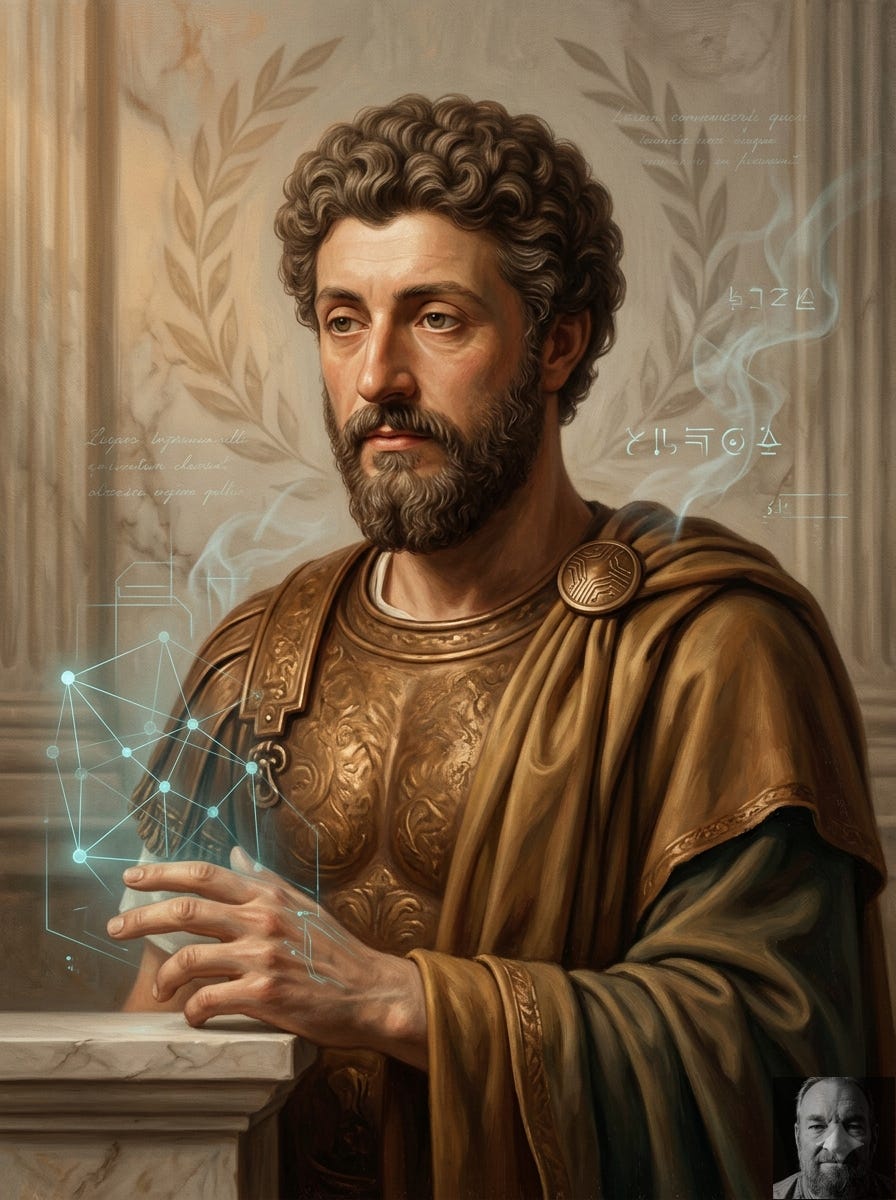
Open any news feed today, and the underlying current is unmistakable: a low-humming existential dread. Headlines scream about the latest artificial intelligence models rendering industries obsolete overnight. We are bombarded with warnings to upskill, optimize, and adapt at a breakneck pace just to keep from being left behind.
The implicit message of the mid-2020s is terrifying: You are an algorithm, and a better one is being coded right now.
This is modern future shock—the paralyzing anxiety that the definition of what it means to be a valuable human being is shifting faster than we can track. In our panic, we fall into the self-improvement trap of trying to out-compute the computers, working longer hours and processing more data.
Escaping Cognitive Utilitarianism
Ancient Stoicism offers a much-needed reality check: you cannot beat a machine at being a machine. Your goal is to remember how to be human.
Our collective panic over technological shifts stems from a modern disease we can call cognitive utilitarianism. For decades, self-help culture has conditioned us to view ourselves as productivity engines. We measure our days by output, speed, and efficiency. When a piece of silicon suddenly synthesizes data, writes code, or drafts a copy in three seconds, our identity collapses.
The Stoic philosopher Epictetus would look at this crisis and diagnose it instantly. He would remind us that we have placed our ultimate good—and our sense of self—in the category of things outside our control. If your identity is anchored to being the fastest processor of information in the room, you have built your house on a fault line.
Machines have always out-powered us physically. Industrial factories replaced human muscle; calculators replaced mental math. The current shift is merely the outsourcing of cognitive labor. To a Stoic, this isn’t a tragedy; it is a clarification. It forces us to stop confusing our human value with our professional output.
This clarification reveals that while an AI can synthesize every philosophical text ever written or generate a moving poem about grief, there is a canyon-sized gap between generating text about virtue and exercising virtue.
A machine cannot make a moral choice or experience the friction of choosing integrity over convenience when no one is watching. It cannot practice prosochê—the deep, intentional, mindful attention of a conscious mind experiencing the present moment. While a machine operates on probabilities, a human operates on character.
Ultimately, the antidote to future shock is the deliberate cultivation of an internal citadel. If the digital landscape changes, the Stoic asks if it prevents them from being patient, honest, or just. If the answer is no, then the core of one’s life remains perfectly intact.
What Cannot Be Coded
The Stoic philosophers dedicated extensive effort to analyzing the hegemonikon, which they identified as the commanding faculty or ruling center of the mind. Marcus Aurelius frequently looked beyond the tumultuous and chaotic political landscape of the Roman Empire to center himself, maintaining that regardless of how the external environment transformed, the fundamental nature of the rational soul remained entirely stable and unaffected.
“Look within. Within is the fountain of good, and it will ever bubble up, if thou wilt ever dig.” — Marcus Aurelius
While modern artificial intelligence possesses the capability to synthesize every philosophical treatise ever penned—producing flawless discourses on courage, poignant poetry regarding grief, or simulated empathy via chatbot interfaces—there exists a profound, “canyon-sized” disparity between the mechanical generation of text about virtue and the actual exercise of virtue.
A machine is fundamentally incapable of making a genuine moral choice. It does not experience the internal resistance or friction involved in selecting integrity over personal convenience, especially when unobserved. Furthermore, a machine cannot engage in prosochê—the profound, intentional, and mindful attention that a conscious being directs toward the present moment. While an algorithm functions based on statistical probabilities, a human being functions through the development and expression of character.
Consequently, the most effective remedy for “future shock” is neither technological withdrawal nor relentless hyper-optimization. Instead, it lies in the intentional development of an “internal citadel” that is not contingent upon external validation or the stability of technology. When faced with a rapidly shifting digital landscape, the Stoic evaluates the situation by asking: Does this change interfere with my capacity for honesty? Does it hinder my patience? Does it obstruct my ability to act with justice? If these core virtues remain accessible, then the essential foundation of one’s life remains entirely intact.
The Silent Practice: The Un-Optimizable Hour
To combat the psychological wear and tear of future shock, we must deliberately engage in acts that have absolutely zero digital or economic value. This week, you are invited to carve out an Un-Optimizable Hour.
Disconnect Entirely: Turn off your phone, close your laptop, and step away from any screen.
Choose an Analog Activity: Engage in something that cannot be tracked, measured, or automated. Write a letter to a friend by hand using a pen and paper. Read a physical book without checking your notifications. Sit in a park and simply observe the world with undivided attention.
Resist the Urge to Produce: If your mind panics and whispers that you are wasting time, gently recognize that thought as an illusion of the optimization trap. Remind yourself that you are practicing the unique human art of intentional presence.
The future will belong to the machines, but the present moment belongs entirely to you. Step out of the race, ground yourself in your own mind, and remember what a machine can never learn: how to simply exist.