

Picture the ancient Stoic teacher Epictetus, walking with a cane through the dusty streets of Nicopolis. He is a freed slave who has endured profound physical suffering, preaching a philosophy of radical internal liberation. Now, imagine pulling an artifact from your pocket and handing it to him: a sleek, glowing smartwatch, buzzing gently against his wrist with a daily stress score.
It sounds like the setup for a cheap historical joke. We tend to imagine ancient Stoicism as a retreat from the noise of the world, a mental fortress built of pure reason. Conversely, our modern wearables often feel like the ultimate tethers to modern anxiety, incessantly vibrating to remind us how poorly we slept, how sedentary we have become, or how fast our hearts are beating. Yet, if you look past the silicon and the illuminated screen, this little device might just be one of the most potent tools for practical philosophy we have invented in the last two millennia.
To understand why, we have to strip Stoicism down to its absolute bedrock. The foundation of everything Epictetus taught is the Dichotomy of Control. There are things that are up to us, and things that are not up to us. Our judgments, intentions, and desires belong to us. Our bodies, reputations, and external circumstances do not. The goal of the Stoic is to focus entirely on the former and cultivate a profound, peaceful indifference to the latter.
But there is a glitch in the human operating system that makes this incredibly difficult in practice. Our minds and bodies are deeply, messily intertwined. When a confrontational email hits your inbox, you do not just experience a calm, rational thought that says, “This is a challenging situation that requires my attention.” Instead, your sympathetic nervous system instantly floods your bloodstream with cortisol. Your chest tightens. Your heart rate accelerates. The physiological response dramatically precedes the rational thought.
In that chaotic moment, the line between what is up to us and what is not completely blurs. You feel the visceral, physical sensation of panic. Because you feel it, your brain immediately starts writing a narrative to justify it. You tell yourself that you are in danger, that you are failing, or that the situation is an unmitigated disaster. You confuse a biological reflex for a philosophical truth.
This is exactly where the smartwatch intervenes, acting as an objective, emotionless dashboard for the human machine.
Imagine looking down at your wrist during that exact same stressful moment. The screen quietly reports a heart rate of 115 beats per minute. It does not judge you. It does not tell you that you are an imposter or that your career is in jeopardy. It simply offers a neutral data point. Your heart is beating faster. That is all.
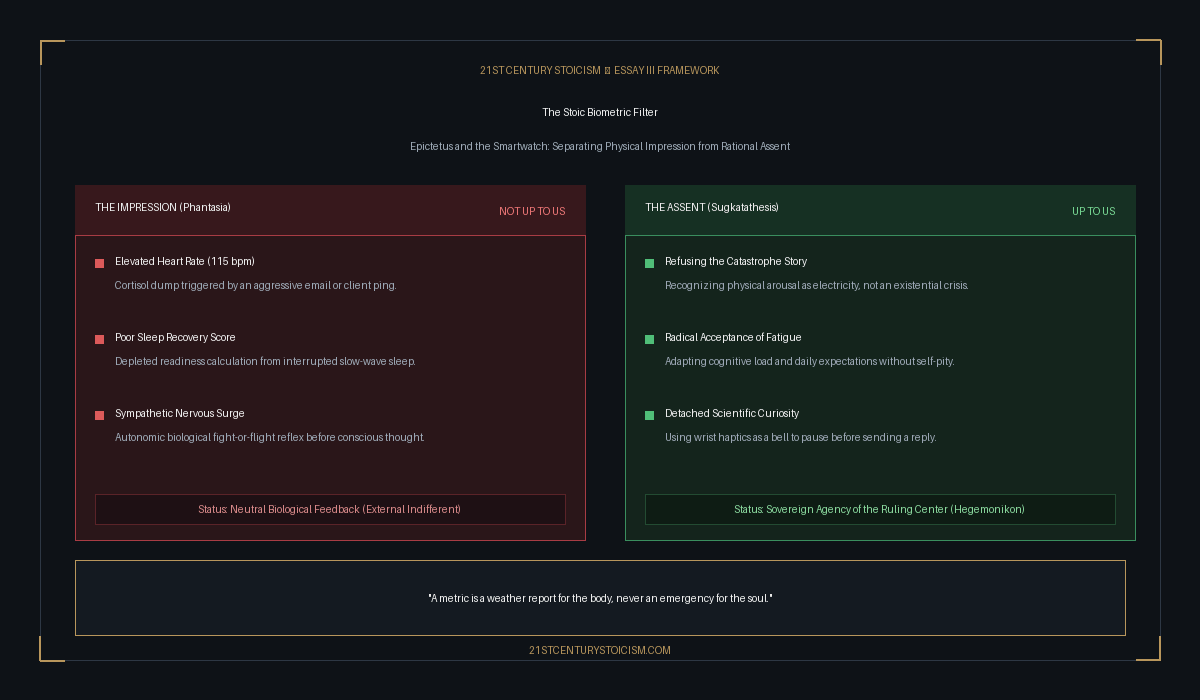
By quantifying the biological reaction, the wearable creates a crucial wedge of space between the physical sensation and the emotional judgment. The Stoics called these initial physical and mental reactions “impressions.” You cannot control the impression. If you hear a loud thunderclap, you will inevitably flinch; it is a hardwired reflex. But you retain absolute control over whether you grant “assent” to that impression—whether you agree with the catastrophic story it is trying to tell you.
When your wearable gives you a concrete number, it helps you step outside of the subjective storm. You can observe your elevated heart rate with the detached curiosity of a scientist. You can say to yourself, “My biological machinery is releasing adrenaline in response to a perceived social threat. How fascinating.” By objectifying the stress, you strip it of its narrative power. You recognize the racing heart as something that belongs strictly to the body—which, as Epictetus reminds us, is ultimately not up to you. What remains up to you is how you proceed to answer the email.
This practice extends far beyond the acute spikes of daily anxiety. Consider the modern obsession with sleep tracking. For many people, waking up to a low sleep score is a self-fulfilling prophecy of misery. They see a poor metric and immediately decide the entire day is ruined, adopting a heavy narrative of exhaustion before their feet have even touched the floor.
But a practicing Stoic looks at that same metric entirely differently. The sleep you had last night is locked in the past. It is entirely outside of your control. The poor metric on your wrist is not a curse; it is merely an accurate assessment of the terrain you must navigate today. Think of it as a weather report for your biology.
If the watch tells you that your deep sleep was lacking and your resting heart rate is elevated, it is simply informing you that your physical resources are currently depleted. The Stoic response is radical acceptance. You acknowledge the low battery. You adjust your expectations for the day, perhaps choosing to delay a highly demanding cognitive task or substituting a grueling workout with a long walk. You do not suffer over the tiredness. You simply manage it. The data liberates you from the vague, heavy fog of fatigue by turning it into a concrete, manageable constraint.
We are not just rational minds floating in the ether. We are animals strapped to a nervous system that evolved for a dangerous, ancient wilderness, not for navigating modern corporate hierarchies, social media algorithms, or endless digital communication. The ancient Stoics knew this intuitively. They practiced rigorous self-examination to catch themselves before they spiraled into emotional turmoil, relying entirely on exhausting introspection to tell the difference between the mind and the flesh.
We have the unique privilege of outsourcing a portion of that self-examination to the sensors resting against our skin. The technology does not do the philosophical work for us. A smartwatch cannot make you virtuous, and a high recovery score cannot make you wise. But it provides a mirror. It forces us to confront the reality of our animal nature with stark, numeric clarity.
When we use these devices not as tools of neurotic obsession, but as instruments of quiet observation, they become digital extensions of the Stoic discipline. They remind us, minute by minute, beat by beat, exactly where the boundary lies between the biology we inherit and the mind we command. So the next time your wrist buzzes to warn you of an elevated heart rate, do not panic. Do not let the mind spin a web of anxiety. Just look at the number, take a breath, and ask yourself the oldest and most vital question: “This is my body’s reaction. But what is up to me?”