



It usually happens during an afternoon lull or late at night while winding down in bed. You scroll past a 3,000-word essay packed with frameworks, book notes, or mental models. You do not have twenty minutes to read it right now, so you tap the bookmark icon, add it to your read-later app, or drop it into a saved folder.
A quiet, imperceptible wave of satisfaction washes over you. You did not read a single sentence, but your subconscious quietly takes credit for the acquisition. You tell yourself you will sit down with it on Saturday morning over coffee.
Saturday arrives, and instead of opening your reading list, you open a fresh feed and bookmark twelve more links.
Within six months, that folder quietly swells to four hundred unread articles. It becomes an archive of good intentions, an uninspected digital attic where insights go to be buried under newer tabs.
We convince ourselves that collecting information is the first step toward wisdom. In reality, amassing unread material is just digital hoarding disguised as ambition.
Seneca and the Illusion of Breadth
Two thousand years before browser tabs, pocket apps, and cloud bookmarks existed, Roman philosopher Seneca noticed this exact human trap.
In his second letter to his friend Lucilius, titled On Discursiveness in Reading, Seneca watched people frantically bouncing between books and acquiring vast collections of unread scrolls just to feel intellectually accomplished. He did not mince words:
“To be everywhere is to be nowhere. People who spend their whole life traveling end up having plenty of places where they can find hospitality, but no real friendships. The same thing necessarily happens to men who apply themselves to no single master thinker, but hastily skim through everything.”
Seneca pointed out that wealthy Romans loved showing off private libraries lined with thousands of rare papyrus rolls, using them as decor to impress guests rather than tools to transform their character:
“Food does no good and is not assimilated into the body if it is vomited up as soon as it is eaten. Nothing hinders a cure so much as frequent change of medicine.”
Having access to every thinker in human history does not make you wise. If you never metabolize the ideas into your actual behavior, collecting them is just an expensive form of avoidance.
The Trap of Synthetic Competence
Why do we hoard unread articles with such obsessive enthusiasm?
Because human biology cannot tell the difference between acquiring the container of knowledge and digesting its substance.
When you hit save on an insightful article, your brain receives an immediate micro-dose of dopamine. You feel the thrill of intellectual discovery without paying the cognitive toll.
Actual comprehension is slow, metabolically expensive, and demanding. It requires sitting in an uninterrupted room, wrestling with dense paragraphs, disagreeing with the author, taking notes in your own handwriting, and testing the principles against your daily work.
Saving a link takes one second. Digesting it takes an hour of focused effort.
When we replace the difficult labor of understanding with the frictionless act of saving, we build synthetic competence. We feel like we are progressing simply because our library is growing. But a library you never read is just clutter that takes up space in your head.
The Ambient Debt of the Unread Queue
Every unread bookmark is an open cognitive loop.
Psychologists have documented this as the Zeigarnik effect: your brain expends background energy keeping track of unfinished commitments. When you glance at a browser bar crowded with fifty open tabs or an inbox filled with newsletters you promised to get to, you are not looking at assets. You are looking at outstanding debts.
Every time you open your device, those lists quietly register in your peripheral vision: You are behind. There is so much you still have not processed.
That low-grade guilt creates ambient fatigue. It scatters your working memory and makes deep focus harder to sustain. Instead of feeling energized by new ideas, you feel constantly burdened by a backlog you will never clear.
The 3-Step Stoic Information Diet
Reclaiming your focus does not mean deleting your browser or ignoring the world. Stoicism is not about avoiding information; it is about establishing strict operational boundaries around what you allow into your mind.
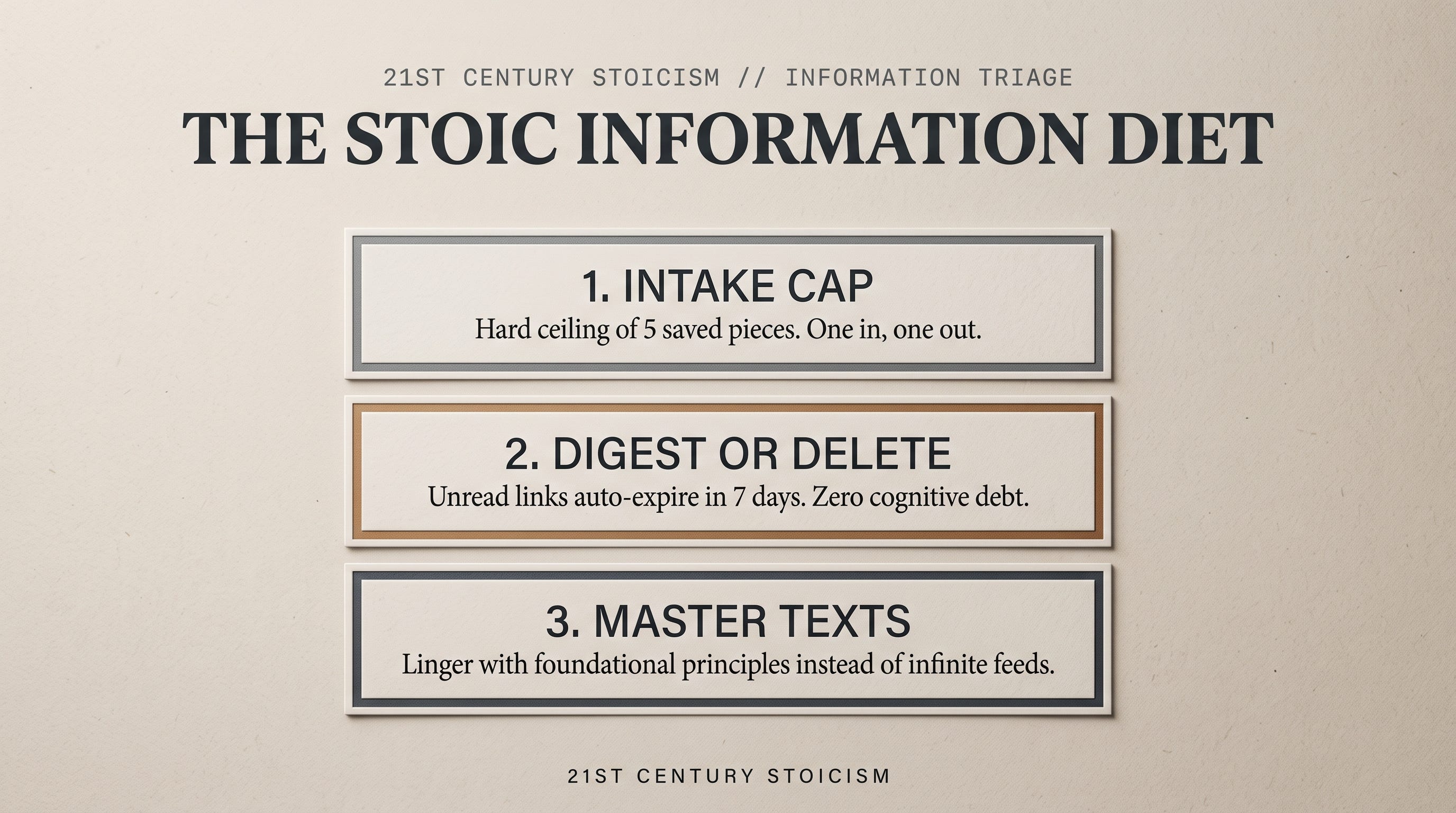
Here is the three-step protocol to dismantle digital hoarding and restore real cognitive digestion:
1. The 5-Article Quarantine
Cap your read-later queue at exactly five articles.
If your list already contains five items, you cannot add a sixth until you either read one or delete one. The moment you introduce artificial scarcity, the fantasy of infinite accumulation ends. You are forced to evaluate every incoming link with honesty: Is this truly worth replacing one of my five slots? If the answer is no, you let it go immediately.
2. The 7-Day Expiration Rule
Treat unread links like fresh produce. If an article sits in your queue for more than seven days, it is deleted automatically without debate.
If an idea was genuinely vital to your business, your health, or your character, you would have made time for it within a week. If you did not touch it in seven days, it was entertainment posing as an obligation. Wipe the slate clean and move on without regret.
3. Master Texts Over Infinite Novelty
Seneca gave Lucilius a simple rule: choose a handful of foundational thinkers and linger with them until their principles become second nature.
“You must linger among a limited number of master thinkers and digest their works, if you would derive ideas which shall win firm hold in your mind.”
One deeply understood framework that you actually execute in your daily life is worth more than five hundred skimmed headlines. Reread the book that changed how you view adversity. Study the essay that gave you clarity. Stop chasing the illusion of novelty and focus on depth.
Closing the Tabs
Clear out the backlog. Delete the saved links you have been carrying for months.
The internet will never run out of essays claiming to optimize your life. The algorithms will continue generating endless content designed to convince you that the next piece of advice holds the missing key.
Your hours, however, are strictly non-renewable.
Stop stockpiling ideas like a hoarder fearing famine. Pick one piece of wisdom, digest it fully, and put it to work in the real world today.
If you want a structured operating system to cut through cognitive clutter and audit daily inputs, explore The Dichotomy Filter Notion Template. It gives you an actionable framework to separate external noise from true priorities.
Stay deliberate,
Torsten