


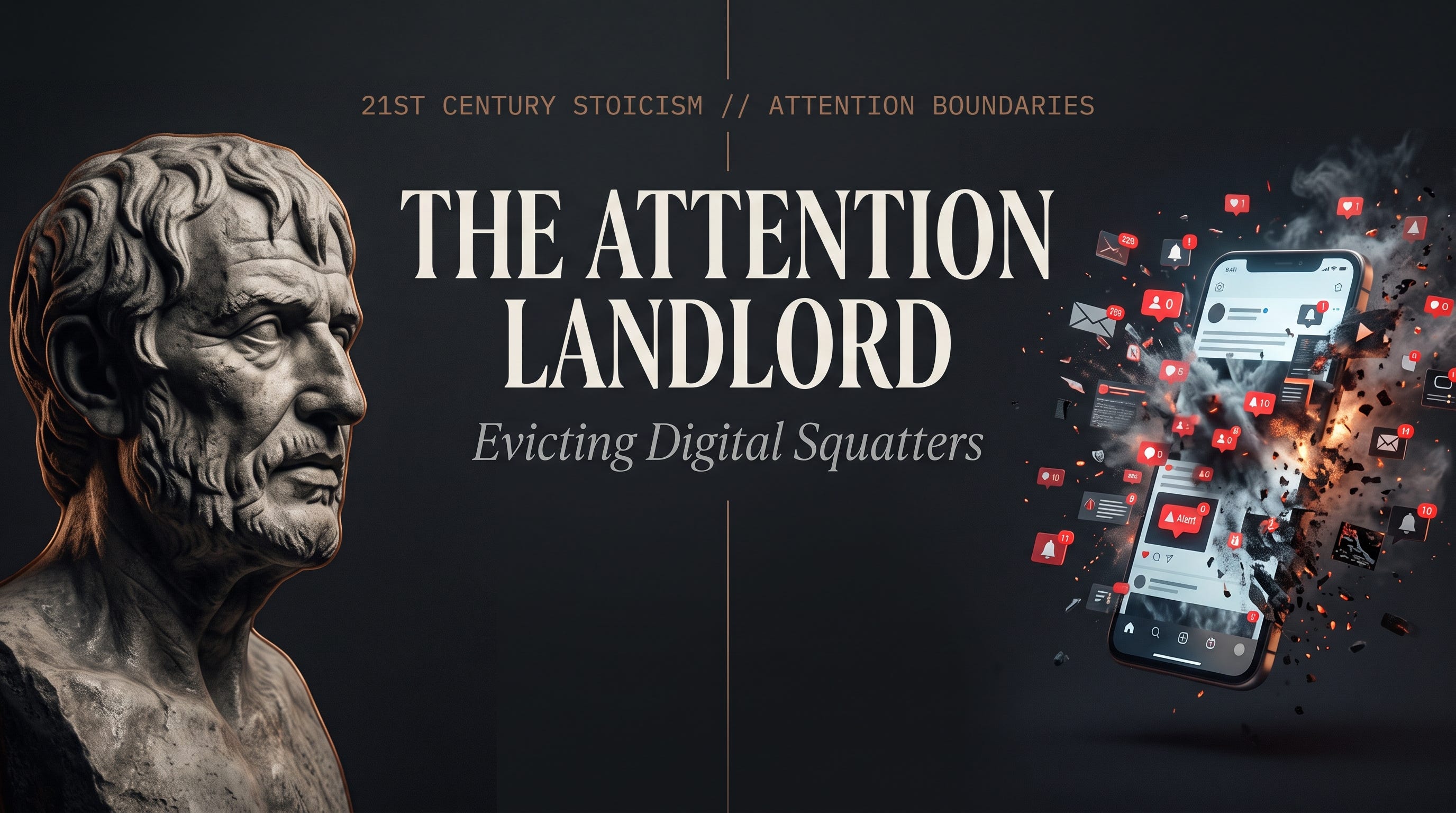
Reclaiming Sovereignty Over Your Screen and Hours
If a complete stranger walked through your front door, kicked their muddy boots up on your coffee table, and demanded that you stop eating dinner with your family to listen to their gossip, you would not politely check their credentials. You would throw them out of your house.
If someone attempted to claim a four-foot strip of your front yard, you would call local authorities or hire a surveyor. We understand property boundaries. We lock our deadbolts, install security cameras, and defend our physical territory with fierce vigilance.
Two thousand years ago, Roman philosopher Seneca observed an astonishing double standard in human nature:
“Men are thrifty in guarding their private property; but as soon as it comes to wasting time they are most extravagant with the one thing in which it is right to be greedy.”
Today, that contradiction has reached absurd heights.
We guard our physical driveways with gates and ring cameras, but the moment we buy a pocket-sized rectangle of glass, we invite forty multi-billion dollar corporations to set up camp inside our nervous systems. We grant them permanent, unmonitored squatter rights to vibrate against our skin, ring bells in our bedrooms, and break our train of thought whenever their algorithms need a bump in monthly active users.
You are the landlord of your cognitive real estate. It is time to serve eviction notices.
The Squatter Economy
Modern applications are not benign software tools waiting quietly in a shed until you need a hammer. They are engineered attention harvesting engines.
Their business model requires squatting on your retinas for as many minutes per day as human biology permits. To maintain occupancy, they deploy behavioral tricks designed by teams of data scientists:
The Red Badge Alarm: Red is a biological threat color. When a tiny red circle appears on your screen, your primitive visual cortex registers an unfinished loop that demands immediate resolution.
The Artificial Emergency: Breaking news banners, trending alerts, and “someone you might know posted a photo” pings. These are not vital dispatches; they are desperate bids to pull you back inside the paywalled garden.
The Frictionless Gateway: Algorithms that anticipate your scroll speed to prevent you from ever encountering a natural exit point.
When you allow an app to send push notifications, you are not simply receiving messages. You are handing an external algorithm the right to confiscate your focus without your consent.
Seneca put it bluntly:
“No person hands over their money to others, yet how many do we each hand our life over to! We are tight-fisted with property and money, yet think nothing of wasting time, the one thing where we should all be miserly.”
The Hidden Tax of Attention Residue
Most people convince themselves that a casual glance at a phone alert costs nothing. I only looked at the banner for three seconds, they say. It did not interrupt my work.
Modern cognitive neuroscience proves Seneca right. When an alert rings and your eyes dart to the screen, your mind pays a heavy biological tax known as attention residue.
Even if you switch back to your spreadsheet or writing within five seconds, a fragment of your working memory remains pinned to the interruption: Who sent that? Is that fire put out? What did that headline mean?
It takes up to twenty-three minutes of uninterrupted cognitive effort for your brain to regain full immersion after a single notification. If your phone buzzes three times an hour, you never actually operate at full mental capacity. You live in a chronic, low-grade cognitive fog, drifting between half-finished thoughts.
The 3-Step Attention Eviction Protocol
Reclaiming your focus does not require moving to an off-grid cabin or throwing your smartphone into the ocean. Stoicism is not monastic escapism; it is operational discipline in the middle of civilization.
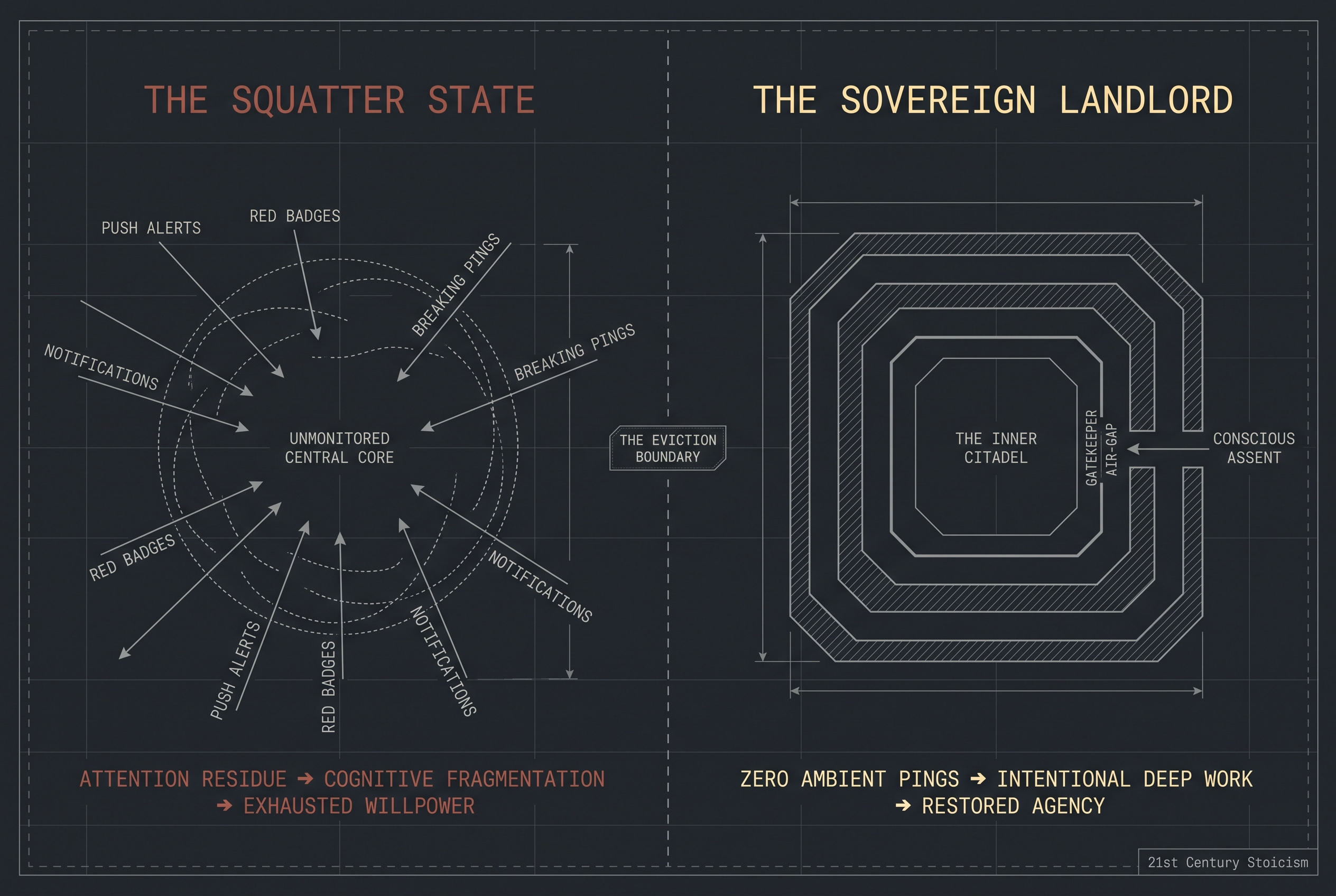
Here is the three-stage protocol to evict digital squatters and reclaim your mind:
1. Revoke the Push-Notification License
Treat push notifications as an extraordinary privilege reserved exclusively for immediate, physical-world crises.
Go into your phone settings right now and conduct a non-negotiable purge:
The Inner Circle Only: The only entities permitted to vibrate or ring your device are direct phone calls from immediate family members, medical providers, or your primary operational backup.
Evict Non-Human Alerts: Turn off banners, sounds, and badges for news feeds, social media platforms, games, retail apps, and podcast players.
The Deliberate Entry Rule: If you want to see what is happening on X, Substack, or news sites, you open the app deliberately at a designated time. The tool serves your intent; it no longer summons you like a trained dog.
2. Clear the Prime Real Estate (The Blank Home Screen)
Real estate agents know that location determines value. Your smartphone home screen is the most expensive real estate you own.
Remove every social media, browsing, and entertainment icon from your first home screen.
Leave only essential utility tools visible: Maps, Notes, Camera, and Calendar.
Force friction onto recreational apps: move them into nested folders on secondary screens or remove them from the home screen entirely, forcing you to type the app name into search to launch it. That three-second pause creates the mental air-gap where conscious assent operates.
3. Establish the Sunset Perimeter
Squatters love the dark. The easiest time for digital noise to colonize your thoughts is late in the evening when your prefrontal cortex is depleted.
Dock your phone at a charging station outside the bedroom at least sixty minutes before sleep.
Replace late-night screen inspection with an analog notebook and a physical book.
End the day by taking inventory of your hours, asking Seneca’s core question: Did I spend today living my life, or was it leased out to strangers?
Becoming a Greedy Landlord
Marcus Aurelius frequently reminded himself that life is short and the present moment is the only thing anyone ever possesses. To surrender your morning hours, your creative energy, and your quiet evenings to algorithmic feeds is to give away your life for pennies.
Be ruthless with your boundaries. Guard your attention with the same ferocity that you guard your physical home. Evict the apps that pay no rent, silence the synthetic alarms, and restore quiet sovereignty to your working mind.
If you want a structured operating system to audit where your attention leaks and track daily boundaries, explore The Stoic Journaling Prompts: Extended Edition. It includes our Situational Protocols and weekly audit frames to keep your digital boundaries airtight.
Stay deliberate,
Torsten