


It is remarkably easy to feel like Marcus Aurelius when sitting alone in a quiet room with an espresso and a leather-bound notebook.
The morning sunlight hits the desk, your phone sits quietly face-down, and your breath is slow and even. In that moment of undisturbed solitude, universal tranquility feels completely manageable. You write a quote about accepting whatever happens, close your journal, and tell yourself that you are grounded in ancient wisdom.
Then 10:15 AM arrives on a humid Saturday morning in historic downtown St. Augustine.
A freight delivery truck double-parks outside, blocking the alley and drawing angry honks from delivery vans. The driver climbs down holding a clipboard, demanding a signature for three heavy pallets right now. At the exact same second, the card reader on register two freezes midway through a sale, three customers form a line at the counter, and someone asks where the public restrooms are.
Your jaw tightens. Your heart rate jumps to 110 BPM.
The leather-bound journal is sitting three miles away on your dining room table, completely useless.
The Internet Aesthetic versus Ancient Reality
Modern social media has turned Stoicism into an interior design aesthetic.
Search for Stoicism online and you will find black-and-white photos of marble statues, minimalist lofts, expensive fountain pens, and serene quotes framed against misty mountains. It portrays philosophy as an elegant pastime for people with unlimited leisure time.
Ancient Stoicism was forged in the absolute opposite environment.
Marcus Aurelius did not write his Meditations while relaxing on a private terrace. He wrote it in a frozen military camp on the Danube River at Carnuntum, surrounded by dying soldiers, mutinous generals, the Antonine plague, and the relentless paperwork of governing an empire on the brink of collapse.
Epictetus was born into slavery, walked with a permanent limp from physical abuse, and taught in noisy Roman marketplaces. Cleanthes, who led the Stoic school after Zeno, spent his nights hauling heavy water jugs through the city streets just to pay for food and parchment.
These men did not view Stoicism as an intellectual luxury. They built it as emergency mental triage for human beings trying to keep their dignity intact while living in the middle of noise, pressure, and uncertainty.
Epictetus and the Arena Floor
Epictetus routinely ridiculed students who spent years memorizing logic problems but fell apart the second real friction arrived.
In his Discourses, he compared philosophy to a wrestling gymnasium, the palaestra:
“Why then do you make yourself out to be a philosopher? Go and wrestle, and do not be so easily thrown. The true student of philosophy is a combatant in the great arena.”
He noted that a ship’s captain does not demonstrate their skill when the harbor water is glassy and the wind is gentle. The pilot proves their competence when the storm rips the mainsail and the crew begins to panic.
A broken register, a missing pallet of inventory, a demanding customer, and a sudden storm that washes out a Saturday afternoon are not interruptions to your philosophical practice.
They are the gymnasium. They are the actual arena.
The 3 Battlefield Protocols
When daily operations spiral out of control, abstract ideas will not save your composure. You need physical, mechanical rules.
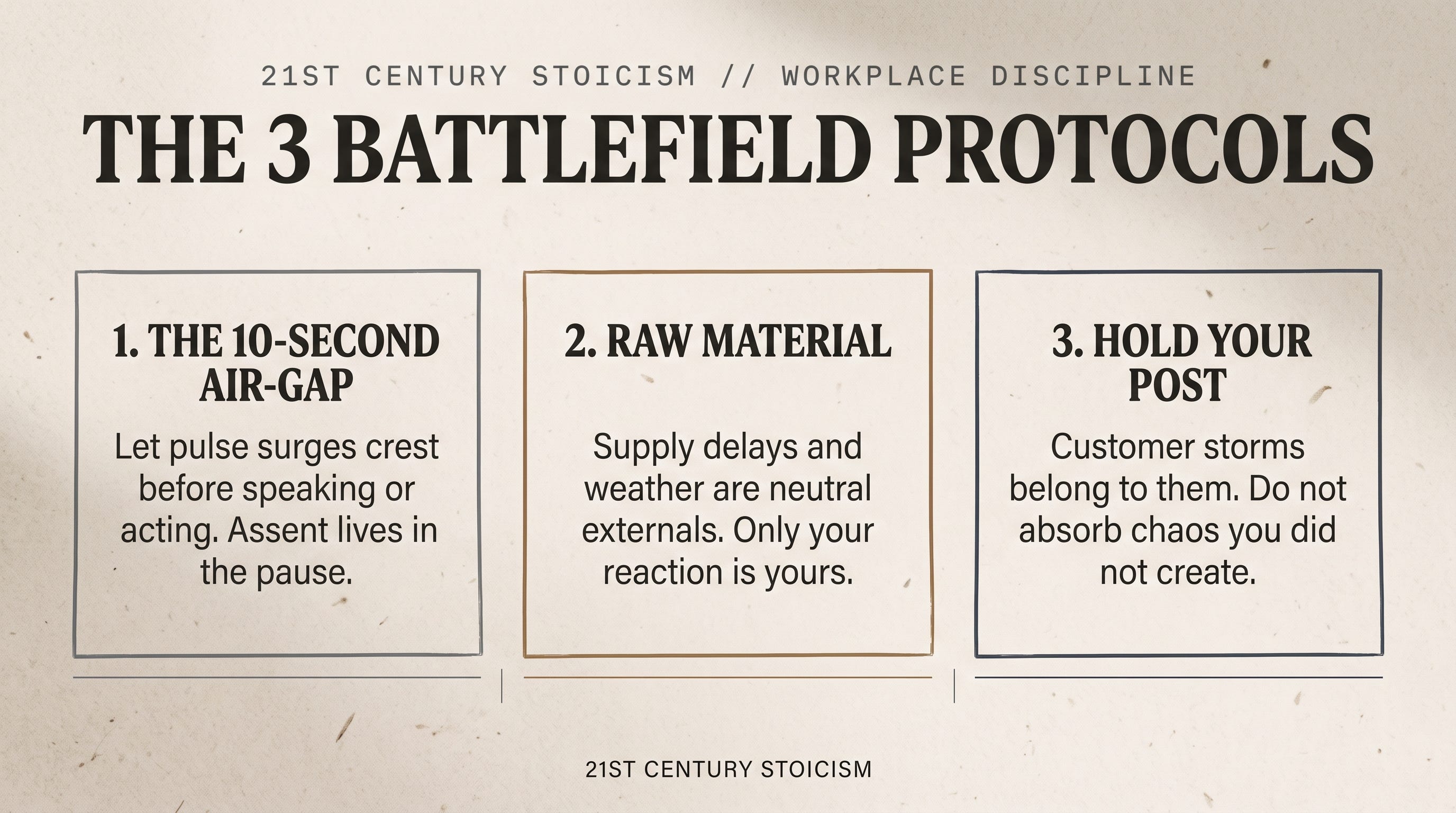
Here are three practical protocols to maintain your agency on the retail floor or in any high-friction workplace:
1. The 10-Second Biological Air-Gap
When a delivery driver slams a clipboard down or a customer raises their voice, your body reacts instantly.
Your sympathetic nervous system dumps adrenaline into your bloodstream, your pupils dilate, and your pulse quickens. That physical surge is an ancient biological reflex, what the Stoics called an impression. It is not a moral failure; it is neutral weather.
The catastrophic error is treating biological adrenaline as an operational command.
When the crisis hits, enforce a mandatory ten-second pause. Do not speak. Do not type an email. Do not sign a dispute. Breathe slowly, let the physical surge reach its peak, and allow your prefrontal cortex to come back online. Assent lives exclusively in that ten-second air-gap.
2. The Freight Dock Dichotomy
The core engine of Stoicism is the dichotomy of control: separating what is up to you from what is not.
On a commercial floor, ninety percent of what happens belongs strictly to externals:
You do not control supplier backorders.
You do not control interstate highway delays.
You do not control sudden afternoon rainstorms.
You do not control the software glitch in your point-of-sale terminal.
What belongs to you? Your posture, your clarity of thought, how you direct your staff, and how you speak to the person standing across the counter.
When a shipment arrives damaged, asking Why does this always happen to me? is childish. Epictetus advised treating external friction like the weather: you do not scream at a rainstorm; you put on a coat and adjust your route.
3. Marcus’s Morning Floor Triage
Every morning before leaving his tent, Marcus Aurelius reminded himself of the exact reality he was walking into:
“When you wake up in the morning, tell yourself: the people I deal with today will be meddling, ungrateful, arrogant, dishonest, jealous, and surly.”
He did not write this out of cynicism. He wrote it to inoculate his mind against surprise.
When a customer arrives at your counter demanding the impossible, they are rarely attacking you personally. They are carrying their own fatigue, marital stress, financial fear, or biological exhaustion into your store.
Your job is not to fix their temperament or convince them of your philosophy. Your job is to hold your post, execute your duties with competence, and refuse to let their storm become yours.
The Real Test
It takes zero discipline to admire Marcus Aurelius while sitting in a leather armchair.
The real test of your character happens when the inventory count is wrong, the phone is ringing, the freight driver is impatient, and you have every excuse in the world to lose your temper.
Put away the theoretical debates. Close the aesthetic quotes. The actual arena is whatever is standing directly in front of you right now.
If you want a concrete, pen-and-paper operating system to audit where your attention leaks and enforce daily boundaries, download the FREE 5-Day Printable Stoic Protocol.
Grabbing the Day 1 worksheet (The Morning Armor Audit) puts you on our daily five-part sequence, delivering one single-page protocol to your inbox each morning with zero digital clutter.
Prefer an automated digital workspace over paper? Explore our full library of situational protocols, decision frameworks, and habit systems at The Silent Wisdom.
Stay deliberate,
Torsten