



You sit down at your desk at 9:00 AM. Your coffee is hot, your calendar is neatly blocked for deep work, and you have written down the three critical priorities that will make the day a win. You feel calm, in control, and deliberate.
Then 10:14 AM arrives.
A critical server crashes. A key client sends an email marked high priority with an implicit threat to walk. A vendor drops a deadline, or an emergency meeting lands on your calendar with ten minutes’ notice. Within ninety seconds, your neat morning architecture collapses into dust.
Your jaw clenches. Your heart rate ticks upward to 105 beats per minute. A spike of irritation burns behind your sternum.
In that precise moment, most people enter a cognitive purgatory known as the “ghost plan” trap. Instead of dealing cleanly with the reality in front of them, their attention splits in two: half of their mind scrambles to put out the immediate fire, while the other half stays trapped in resentment, silently mourning the productive day they were supposed to have.
They treat the disruption as an affront—a personal attack by the universe on their carefully crafted productivity system.
Two thousand years ago, Roman Emperor Marcus Aurelius sat in a military tent along the freezing Danube border at Carnuntum. He was not philosophizing in a quiet Mediterranean courtyard with a cup of wine. He was managing an empire struck simultaneously by the Antonine Plague, northern Germanic invasions, bankruptcy, and political betrayal.
His journal entries were not abstract theoretical treatises. They were field notes on surviving the daily fire drill.
The Myth of the Uninterrupted Life
Modern productivity culture sells a seductive fantasy: if you just download the right app, time-block with enough rigor, and wake up at 5:00 AM, you can engineer an uninterrupted, frictionless existence.
Ancient Stoics knew this was delusional. Marcus reminded himself every single morning:
“When you wake up in the morning, tell yourself: The people I deal with today will be meddling, ungrateful, arrogant, dishonest, jealous, and surly. They are like this because they cannot distinguish good from evil.”
Marcus was not being cynical; he was running a reality calibration.
When you expect the terrain of a workday to be smooth, every pothole feels like a catastrophe. But when you recognize that a modern business, a digital network, and human organizations are volatile, complex systems, unexpected interruptions cease to be moral failures. They are simply the weather.
The moment your calendar breaks, the greatest danger is not the crisis itself. The danger is the secondary emotional narrative you attach to it: Why does this always happen to me? I will never get caught up. My entire week is ruined.
That narrative is what the Stoics called false assent (synkatathesis). The crisis is objective reality. The panic is your own addition.
Amor Fati as an Operational Triage
Philosophers often discuss Amor Fati—the love of one’s fate—as a grand, poetic ideal. They quote Friedrich Nietzsche or picture ancient sages smiling serenely through tragic exile.
In daily operations, Amor Fati is far more practical: it is a rapid-reset circuit breaker.
It means that the moment external conditions shatter your plan, you refuse to waste a single milligram of cognitive bandwidth wishing reality were different. You do not argue with a server crash. You do not litigate the unfairness of a client’s demands while the house is smoking.
Marcus Aurelius phrased it with surgical clarity:
“The impediment to action advances action. What stands in the way becomes the way.”
When your 10 AM fire drill lands, that fire drill is your new work. The test of your character is not whether you can execute a perfect plan in a sterile vacuum; it is whether you can bring order, virtue, and quiet competence to the chaos you did not choose.
The 3-Step Stoic Triage Protocol
When the inevitable crisis hits your desk, do not rely on raw willpower or frantic multitasking. Execute this three-stage protocol:
1. The Biological Air-Gap (T + 2 Minutes)
When bad news arrives through a screen, your sympathetic nervous system fires instantly. Epictetus called this initial shock phantasiai—the raw impression. You cannot prevent the adrenaline surge; your body evolved to react before your conscious mind weighs in.
What you can control is the gap between that surge and your response:
Step away from the keyboard immediately.
Do not type, reply, or escalate while your pulse is elevated.
Close your laptop lid or set your phone screen-down for sixty seconds.
Breathe out slowly and remind yourself: This is a physical sensation. My capacity for sound judgment remains untouched.
2. Apply the Dichotomy Filter (T + 5 Minutes)
Pull out a physical notepad and draw a clean vertical line down the page. Split the crisis into two non-negotiable columns:
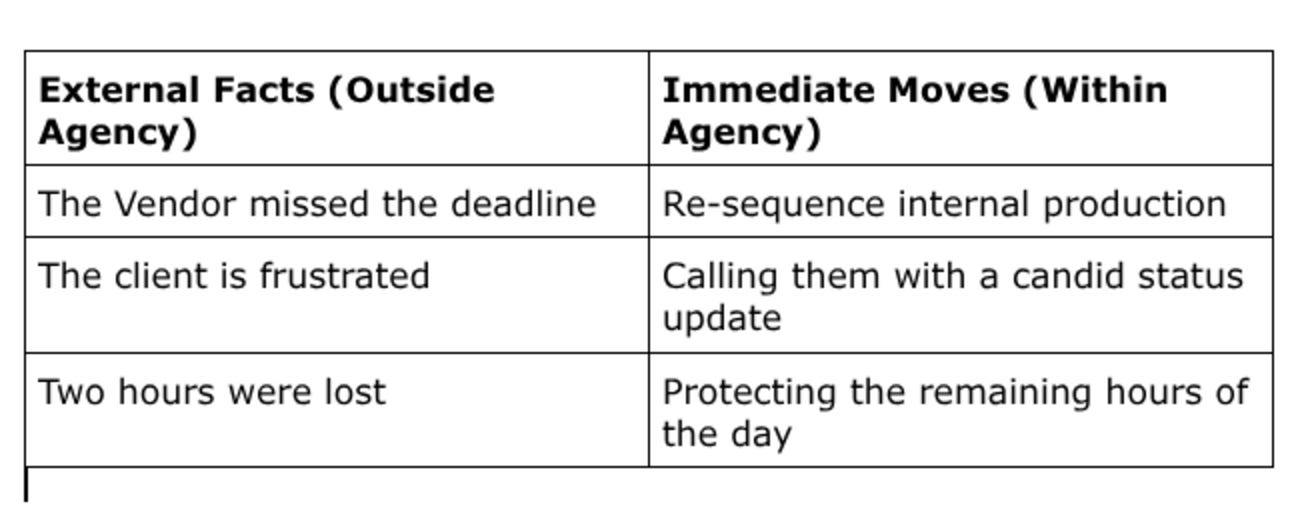
Notice how this strips the crisis of emotional static. You surrender all claim over what has already occurred, and direct 100% of your remaining fuel toward the single lever you can pull right now.
3. Declare “Ghost Plan” Bankruptcy
The fatal mistake is trying to squeeze eight hours of planned tasks into the three chaotic hours remaining in your day. It creates chronic low-grade anxiety and guarantees half-assed execution across the board.
Formally declare bankruptcy on your morning schedule:
Open your task manager and reschedule today’s secondary and tertiary priorities to tomorrow or later in the week.
Identify the Single Essential Action required to stabilize the disruption.
Focus entirely on that action with full presence. When you finish it, reassess the terrain.
The True Measure of Practice
Anyone can appear focused and philosophical when notifications are silent, meetings are canceled, and the calendar behaves. That is easy.
The real arena of Stoic practice is the crowded inbox, the derailed project, and the unexpected crisis that blows up your Tuesday morning. When the fire drill starts, you do not need more productivity hacks. You need a disciplined mind that knows how to drop what it cannot control, steady its hands, and step forward into the mess.
Plan your day with discipline. But when the plan breaks, welcome the friction as the training ground it has always been.
If you want a concrete, digital framework to audit unexpected disruptions and triage your daily focus, explore The Dichotomy Filter. It is an operational Notion dashboard built to separate daily chaos from your sphere of agency in real time.
Stay deliberate,
Torsten
I find it interesting how you've applied Stoic philosophy to the corporate world. Many of these principles resonate with my own beliefs about acceptance, mindfulness and understanding. Ive approached them more thru life experiences, so i appreciate seeing them thru a different perspective.